Last updated: November 2026
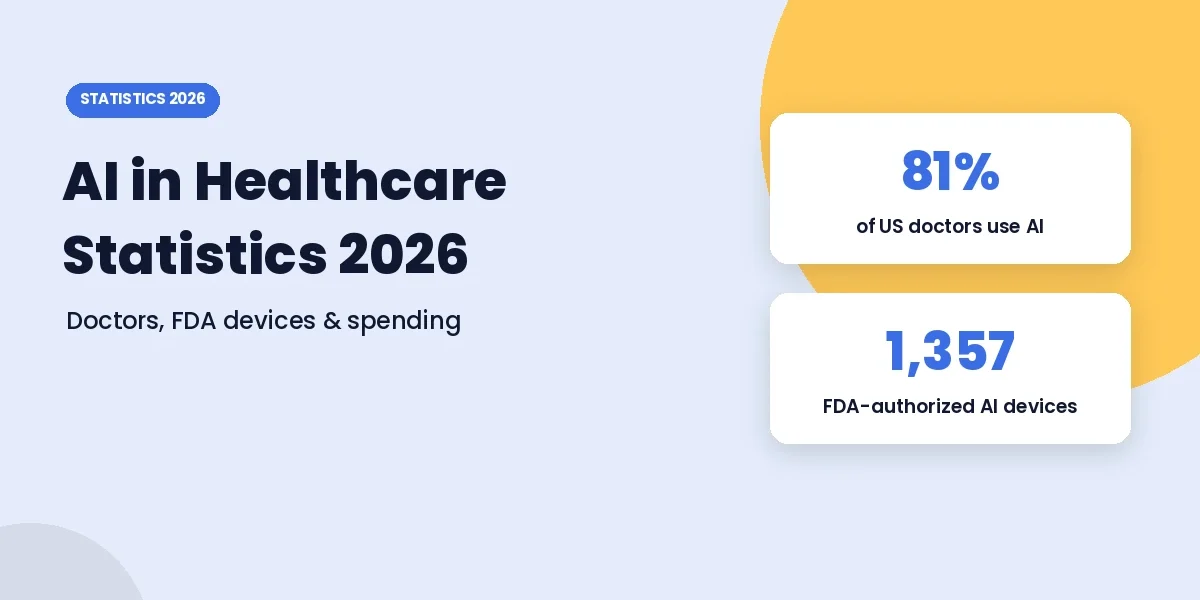
81% of US physicians used AI in their practice in early 2026, up from 38% in 2023, according to the American Medical Association. The FDA had authorized 1,357 AI-enabled medical devices by December 2025, according to Stanford HAI’s 2026 AI Index. Adoption is real, but the evidence base is thinner than the marketing. This page covers physician use, FDA authorizations, health-system spending, ambient scribes, clinical accuracy and patient behavior, with every figure sourced and dated.
US physicians using AI in their practice, early 2026, up from 38% in 2023.
Source: American Medical Association
AI-enabled medical devices authorized by the FDA, cumulative to December 2025.
Source: FDA data via Stanford HAI, AI Index 2026
AI medical devices authorized by the FDA in 2025, a record year.
Source: FDA data via Stanford HAI, AI Index 2026
Share of FDA-authorized AI devices in radiology, through 2025.
Source: FDA data via Stanford HAI, AI Index 2026
Healthcare AI spending in 2025, nearly triple 2024.
Source: Menlo Ventures
US health systems that have deployed domain-specific AI tools, 2025.
Source: Menlo Ventures
Reduction in note-writing effort reported by Sharp HealthCare with ambient AI scribes, 2025.
Source: Stanford HAI, AI Index 2026
FDA-authorized AI devices with clinical studies backed by randomized trial data.
Source: Stanford HAI, AI Index 2026
Key Takeaways
- The average US physician used AI for 2.3 tasks in 2026, up from 1.1 in 2023 (American Medical Association).
- 88% of US physicians are concerned about skill loss from relying on AI (American Medical Association, 2026).
- Healthcare organizations are deploying AI at 2.2 times the rate of the broader US economy (Menlo Ventures, 2025).
- Providers account for $1 billion, or 75%, of 2025 healthcare AI spending (Menlo Ventures).
- Ambient AI adoption reached 63% among hospitals using Epic’s electronic health record (Stanford HAI, 2026).
- Only 5% of more than 500 clinical AI studies reviewed used real clinical data (Stanford HAI, 2026).
- 20% of US chatbot users use AI chatbots for medical advice (Pew Research Center, February 2026).
How many doctors use AI in 2026?
81% of US physicians use AI in their practice, more than double the 38% reported in 2023, according to the American Medical Association’s 2026 Physician Survey on Augmented Intelligence. The AMA surveyed 1,692 physicians between January 15 and February 2, 2026.
Physicians mostly use AI for paperwork and research, not diagnosis. 39% of physicians use AI to summarize medical research and standards of care, and 30% use it to create discharge instructions, care plans or progress notes, according to the AMA. The average physician used AI for 2.3 tasks in 2026, up from 1.1 in 2023.
Enthusiasm comes with conditions. 76% of physicians say AI improves their ability to care for patients, up from 65% in 2023, while 88% worry about skill loss, according to the AMA. 40% say they are equally excited and concerned, and 70% see AI as a way to automate the tasks that drive burnout. 86% say data privacy and 88% say safety and efficacy validation are critical for wider adoption. Separately, the evidence-search tool OpenEvidence reported use by 40% of US physicians, according to Stanford HAI’s 2026 AI Index.
| Measure | 2023 | 2026 |
|---|---|---|
| Physicians using AI in practice | 38% | 81% |
| Average AI use cases per physician | 1.1 | 2.3 |
| Say AI improves their ability to care for patients | 65% | 76% |
| Use AI to summarize research and standards of care | Not reported | 39% |
| Concerned about skill loss from AI | Not reported | 88% |
| Want to be consulted on AI adoption decisions | Not reported | 85% |
Source: American Medical Association, 2026 Physician Survey on Augmented Intelligence, March 2026
How many AI medical devices has the FDA approved?
The FDA had authorized 1,357 AI-enabled medical devices from 693 companies across 17 clinical specialties by December 2025, according to Stanford HAI’s 2026 AI Index. An FDA authorization means the agency cleared or approved the device for sale; it does not mean the device was tested in a randomized trial.
The pace keeps rising. The FDA authorized 258 AI medical devices in 2025, counted through September, which already exceeded every prior full year, according to the AI Index. The cumulative total crossed 1,000 devices in 2024, and 98 new companies entered the market in 2025.
Most devices skip new trials. 246 AI/ML imaging devices were cleared through the FDA’s 510(k) pathway in 2025, which relies on equivalence to an existing device, according to the AI Index. Only 2.4% of devices with clinical studies were backed by randomized controlled trial data, according to a peer-reviewed analysis of all 1,016 authorizations through December 2024 cited in the report.
Source: FDA data via Stanford HAI, The 2026 AI Index Report, Chapter 6: Medicine, April 2026 (2025 counted through September)
Which medical specialties use AI the most?
Radiology accounts for 1,039 of the 1,357 FDA-authorized AI devices, or 76.6%, according to Stanford HAI’s 2026 AI Index. Cardiovascular devices follow with 130 authorizations (9.6%), and neurology has 61 (4.5%).
AI is spreading beyond imaging, slowly. Non-radiology AI authorizations rose from 7 in 2016 to 60 in 2025, according to the AI Index. Cardiology, neurology, anesthesiology and gastroenterology-urology have all accelerated since 2020.
The vendor market is broad but top-heavy. GE Healthcare holds 93 authorized AI devices and Siemens Healthineers 82, according to the AI Index, while most of the 626 companies with at least one authorization hold only one or two.
Source: FDA data via Stanford HAI, The 2026 AI Index Report, Chapter 6: Medicine, April 2026
How much do healthcare organizations spend on AI?
Healthcare AI spending reached $1.4 billion in 2025, nearly triple the 2024 total, according to Menlo Ventures’ 2025 State of AI in Healthcare report. Healthcare organizations are deploying AI at 2.2 times the rate of the broader US economy, according to the same report.
22% of healthcare organizations have deployed domain-specific AI tools, a sevenfold increase from 2024, according to Menlo Ventures. Health systems lead at 27% adoption, ahead of outpatient providers at 18% and payers at 14%. Providers account for $1 billion, or 75%, of the $1.4 billion spent in 2025.
Startups are capturing most of the money. Startups take 85% of healthcare AI spending, according to Menlo Ventures, and buying cycles are 18% shorter for health systems and 22% shorter for outpatient providers. Founders raising in this space can see recent rounds in our list of recently funded startups, and many of the largest are based among Silicon Valley startups.
Source: Menlo Ventures, 2025: The State of AI in Healthcare, October 2025
Do AI scribes reduce doctor burnout?
Ambient AI scribes, tools that draft clinical notes from a recorded patient visit, saw the broadest adoption of any clinical AI category in 2025, according to Stanford HAI’s 2026 AI Index. Sharp HealthCare reported an 83% reduction in note-writing effort, according to the report.
Results held across several health systems. Northwestern Medicine physicians who used the tool in more than half of encounters saw 11.3 more patients per month and cut documentation time by 24%, with a reported 112% return on investment, according to the AI Index. A Stanford Health Care study of 48 physicians found a median saving of 20 minutes per half day of clinic, along with significant drops in burnout.
Scale is arriving fast. Abridge expanded from about 100 to more than 150 health systems in 2025, and ambient AI adoption reached 63% among hospitals using Epic’s electronic health record, according to the AI Index. Sepsis prediction is the other proven workflow: the TREWS system reported an 18.7% relative reduction in sepsis mortality across 13 Cleveland Clinic hospitals.
| Health system | Tool type | Reported outcome |
|---|---|---|
| Sharp HealthCare | Ambient scribe | 83% less note-writing effort |
| University of Chicago Medicine | Ambient scribe | 47% lower cognitive load |
| MaineHealth | Ambient scribe | 23% less time on notes |
| Northwestern Medicine | Ambient scribe | 11.3 more patients per month; 112% ROI |
| Cleveland Clinic (13 hospitals) | Sepsis prediction (TREWS) | 18.7% relative drop in sepsis mortality |
| UC San Diego Health | Sepsis prediction (COMPOSER) | 17% drop in sepsis mortality |
Source: Stanford HAI, The 2026 AI Index Report, Chapter 6: Medicine, April 2026 (self-reported by health systems)
How accurate is AI in healthcare?
A Microsoft multi-agent AI system scored 85.5% on difficult published diagnostic cases, compared with about 20% for 21 practicing physicians working without their usual tools, according to Stanford HAI’s 2026 AI Index. Benchmark wins like this do not yet show better patient outcomes.
The research base is thin. A January 2026 review of more than 500 clinical AI studies found that nearly half used exam-style questions and only 5% used real clinical data, according to the AI Index. A separate benchmark found leading general-purpose language models made 11.8 to 14.6 severely harmful recommendations per 100 clinical cases.
Patients are already using AI anyway. Google AI Overviews appeared on 84% to 92% of health-related searches, according to the AI Index. 20% of US chatbot users use AI chatbots for medical advice, according to the Pew Research Center’s February 2026 survey. Prospective clinical trials of imaging AI grew from 417 papers in 2024 to 536 in 2025, a sign the evidence is starting to catch up.
| Measure | Figure | Period |
|---|---|---|
| Multi-agent AI accuracy on complex diagnostic cases | 85.5% (physicians about 20%) | 2025 |
| Clinical AI studies using real clinical data | 5% of 500+ reviewed | Review published January 2026 |
| Severely harmful recommendations, leading LLMs | 11.8 to 14.6 per 100 cases | 2025 benchmark |
| AI devices with clinical studies backed by RCT data | 2.4% | Authorizations through Dec 2024 |
| Papers reporting prospective imaging AI trials | 536 (up from 417) | 2025 vs. 2024 |
Source: Stanford HAI, The 2026 AI Index Report, Chapter 6: Medicine, April 2026
FAQ
What percentage of doctors use AI?
81% of US physicians used AI in their practice in early 2026, up from 38% in 2023, according to the American Medical Association’s 2026 Physician Survey on Augmented Intelligence. The most common use, at 39% of physicians, is summarizing medical research and standards of care.
How many FDA-approved AI medical devices are there?
The FDA had authorized 1,357 AI-enabled medical devices by December 2025, according to FDA data in Stanford HAI’s 2026 AI Index. Radiology accounts for 1,039 of them, or 76.6%.
How much is spent on AI in healthcare?
Healthcare AI spending reached $1.4 billion in 2025, nearly triple 2024, according to Menlo Ventures. Providers account for $1 billion, or 75%, of that spending.
Do AI scribes reduce physician burnout?
Health systems report large documentation savings, including an 83% reduction in note-writing effort at Sharp HealthCare, according to Stanford HAI’s 2026 AI Index. A Stanford Health Care study of 48 physicians found significant reductions in burnout and a median saving of 20 minutes per half day of clinic.
Is AI in healthcare reliable?
Only 2.4% of FDA-authorized AI devices with clinical studies were backed by randomized trial data, according to Stanford HAI’s 2026 AI Index. A review of more than 500 clinical AI studies found only 5% used real clinical data.
Cite this page: “AI in Healthcare Statistics 2026: Physician Adoption, FDA Devices and Spending.” GrowthNavigateFunding.net, 2026. https://growthnavigatefunding.net/ai-in-healthcare-statistics/
Sources
- American Medical Association, AMA: AI usage among doctors doubles as confidence in technology grows (2026 Physician Survey on Augmented Intelligence, March 2026)
- Stanford HAI, The 2026 AI Index Report, Chapter 6: Medicine (April 2026)
- Menlo Ventures, 2025: The State of AI in Healthcare (October 2025)
- Pew Research Center, Americans and AI 2026: Chatbots, Smart Devices and Views on Impact (2026)