Silicon Valley startups are technology and innovation ventures headquartered in the San Francisco Bay Area — the world’s #1 ranked startup ecosystem. Home to 337 active unicorns, $90 billion in 2024 venture capital, and a commanding position in AI, Fintech, Biotech, and Robotics, the Bay Area produces more high-growth companies per square mile than anywhere else on Earth.
What Makes Silicon Valley the World’s Top Startup Ecosystem
No other region combines capital density, technical talent, and institutional infrastructure at Silicon Valley’s scale. That combination is self-reinforcing — and it keeps compounding.
The Numbers Behind the #1 Ranking
The raw figures are striking. Silicon Valley’s ecosystem generated $1.8 trillion in value between H2 2022 and 2024, against a global average of $20.4 billion. According to data from TechCrunch, Bay Area startups attracted $90 billion in venture capital in 2024 — 57% of the $178 billion invested in U.S. startups that year.
Ecosystem Snapshot — 2024/2026
- Ecosystem value: $1.8 trillion (H2 2022–2024)
- VC invested in 2024: $90 billion (57% of all U.S. VC)
- Active unicorns: 337 (global average: 4)
- Median seed round: $2.1M (global average: $889K)
- Average time to exit: 8.5 years
The median Series A round in Silicon Valley sits at $12 million, nearly double the global average of $6.8 million. Exit counts have fallen from 549 in 2021 to 283 in 2024, reflecting a market that is more selective, not less ambitious.
The Infrastructure No Other Ecosystem Has Replicated
Y Combinator, the world’s most proven pre-seed accelerator, operates from the Bay Area alongside 50 other accelerators and a network of 200 co-working spaces. Stanford and UC Berkeley supply a continuous pipeline of technical founders — in 2026, Stanford HAI merged with the Stanford Data Science initiative, a structural bet on academic openness as a long-term differentiator.
Big Tech adjacency matters too. Google, NVIDIA, Meta, and Apple function simultaneously as acquirers, strategic partners, and investors in the startup ecosystem. Sequoia, Andreessen Horowitz, Benchmark, Kleiner Perkins, and Lightspeed are all headquartered here. Andreessen Horowitz raised $15 billion across five funds in early 2026. The VC network is not just nearby — it is structurally embedded in the ecosystem.
The Hot Sectors: Where Silicon Valley Startups Are Winning in 2026
Six sectors are pulling significantly ahead of the rest.
Artificial Intelligence — The Defining Category
AI is not just a sector in Silicon Valley right now. It is the organizing principle of the entire ecosystem.
AI startups captured 41% of all venture dollars on Carta’s platform in 2025 — a record. CB Insights reports that AI accounted for nearly half of all venture funding globally that year, with mega-rounds dominating deal flow.
The more important shift is qualitative. Agentic AI has become the dominant enterprise deployment thesis: Silicon Valley firms are moving beyond standalone models toward governed systems of AI agents that reason and act across real-world business workflows. The “build a chatbot” era is over. The current generation builds orchestration layers, vertical agents, and autonomous decision systems.
Vertical AI is proving itself in regulated sectors. Hippocratic AI and Harvey demonstrate that domain-specific AI commands multi-billion-dollar valuations when it solves acute labor shortages or compliance bottlenecks. Eve, another Bay Area legal-tech startup, raised $103 million at a $1 billion valuation and serves more than 450 law firms — further confirmation that regulated industries are no longer resisting AI disruption; they are actively funding it.
At the foundation model layer: OpenAI sits at a $500 billion valuation; Anthropic at $183 billion after aggressive revenue growth. As reported by CNBC, OpenAI closed a $40 billion round in 2025 — the largest single private fundraise in history.
Biotech and AI-Native Drug Discovery
South San Francisco is home to over 250 biotech companies across 12 million square feet of lab space, with Stanford-linked networks feeding partnerships and spinouts. The new development is the convergence of AI with biology.
LatentLabs, founded by a former DeepMind scientist, raised $50 million to design synthetic proteins computationally. Companies combining AI with biological data are achieving 3.2× higher valuations than traditional healthcare software startups. California’s 2026 Senate Bill 829 proposes a state-funded institute for Life Sciences R&D — adding potential structural support to a sector already moving fast.
Fintech and the New Regulatory Landscape
Silicon Valley remains the world’s most consequential Fintech hub, where incumbent networks and AI-native startups compete and collaborate on shared infrastructure. The GENIUS Act, signed into law in 2025, created the first federal framework for stablecoin issuers in the U.S. — converting a long-standing regulatory risk into a structured opportunity for Bay Area crypto and Fintech firms.
CleanTech and the Fusion Energy Bet
Responsible innovation has moved from talking point to capital allocation thesis. The most dramatic bet: Pacific Fusion is a Silicon Valley startup targeting commercial fusion power plants by the 2030s, having secured $900 million in funding. That is not a science project. It is a commercial development program with institutional backing on a defined timeline.
Defense Tech — Silicon Valley’s Newest Frontier
The cultural divide between Silicon Valley and U.S. defense has largely collapsed. In December 2024, Palantir, Anduril, SpaceX, and OpenAI formed an alliance to compete for U.S. defense contracts, challenging traditional defense contractors by applying Silicon Valley’s build-fast approach to national security technology. Skydio develops autonomous drones for military and civilian dual-use, backed by $740 million in VC funding. Dual-use technology is now a legitimate, well-funded startup category.
Top Silicon Valley Startups to Watch in 2026
These companies represent the current state of the ecosystem across major sectors — selected for funding momentum, valuation trajectory, or technological significance.
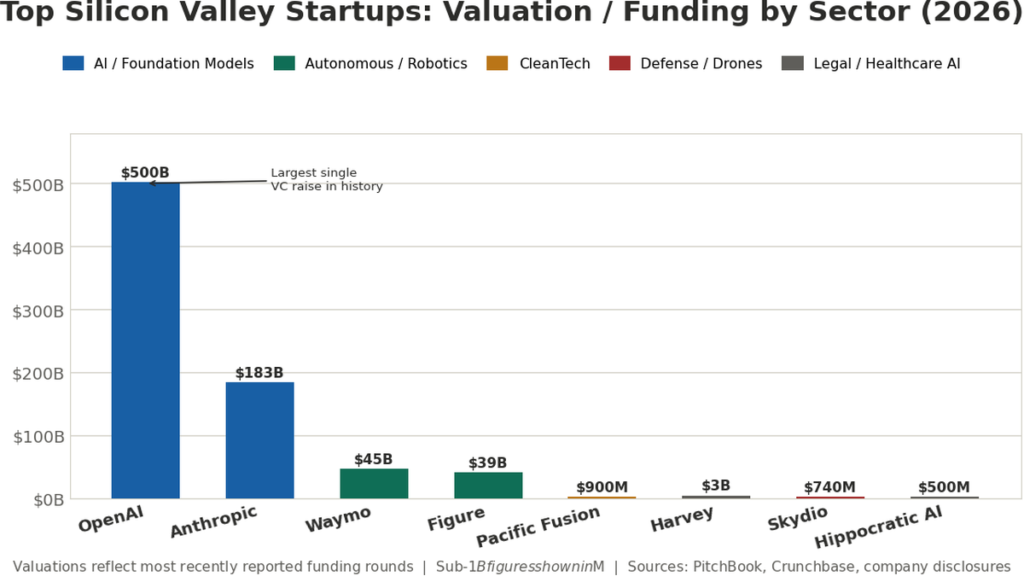
| Startup | Sector | Founded | Funding / Valuation | Why It Matters |
| OpenAI | AI / Foundation Models | 2015 | $500B valuation | Largest single VC raise in history ($40B, 2025) |
| Anthropic | AI / Foundation Models | 2021 | $183B valuation | Constitutional AI; $30B+ ARR run rate |
| Waymo | Autonomous Vehicles | 2009 | $45B valuation | Largest operational autonomous vehicle deployment globally |
| Figure | AI Robotics | 2022 | $39B valuation | Fastest-scaling humanoid robotics company in history |
| Pacific Fusion | CleanTech / Fusion | ~2022 | $900M raised | Commercial fusion power target: 2030s |
| Harvey | Legal AI | 2022 | $3B+ valuation | Proves vertical AI commands premium valuations in regulated sectors |
| Skydio | Defense / Drones | 2014 | $740M raised | Autonomous drones; military and civilian dual-use |
| Hippocratic AI | Healthcare AI | 2023 | $500M+ raised | AI healthcare staffing agent; addresses clinical labor shortages |
| LatentLabs | Biotech / AI Drug Discovery | 2024 | $50M raised | Synthetic protein design; former DeepMind founder |
| Eve | Legal Tech | 2022 | $1B valuation | 450+ law-firm customers; vertical AI credibility in compliance |
Valuations reflect most recently reported funding rounds.
How Silicon Valley Compares to Other Global Silicon Valley-Style Startup Hubs
Silicon Valley’s dominance is real. So are its challengers. With 80% of AI funding concentrated in Silicon Valley, Beijing, and Paris, other regions risk falling behind — but several hubs have built genuine sector-specific strengths.
| Hub | 2024 VC Funding (est.) | Active Unicorns | Dominant Sectors | Key Advantage | Key Weakness vs. SV |
| Silicon Valley | $90B (57% of U.S.) | 337 | AI, Fintech, Biotech, Robotics | Capital density + talent pipeline | Cost of living; visa complexity |
| New York City | ~$18B | 100+ | Fintech, Media, Healthcare | Financial sector access | Thinner deep tech infrastructure |
| London | ~$15B | 50+ | Fintech, AI | Regulatory sophistication; EU access | Smaller VC pool; thinner exit market |
| Beijing | Est. $25B+ | 100+ | AI, E-commerce, EVs | State-backed scale capital | Geopolitical access restrictions |
| Austin | ~$5B | 20+ | SaaS, Semiconductors | Lower cost base; talent migration | Early-stage ecosystem still maturing |
Sources: Startup Genome GSER, CB Insights 2025/2026.
Bay Area clustering persists. Despite years of “Silicon Anywhere” rhetoric, the most consequential AI startups still concentrate around San Francisco. London-launched 11x AI relocated to Silicon Valley to access larger capital pools, later raising a $24 million Series A. That migration pattern tells you what the ranking tables don’t: for founders targeting global scale, the Bay Area pull remains stronger than the cost-of-living push.
What It Actually Takes to Get a Silicon Valley Startup Funded in 2026
The funding environment has shifted more in the past two years than in the previous decade.
The New Investor Bar for Silicon Valley Startups
The days of funding “just another chatbot” are over. In 2026, investor selection has become materially stricter. For AI startups specifically, founder pedigree is now table stakes: ex-OpenAI, Google DeepMind, Meta FAIR, or Stanford PhD backgrounds are the baseline expectation at top-tier funds, not a differentiator.
Proprietary data is the second filter. Fine-tuning an open-source LLM is not a defensible moat — the availability of capable open-source models has raised the floor for what counts as genuine technical differentiation. Unique datasets, novel architectures, or sector-specific deployment expertise are what move deals forward.
Round Sizes Have Inflated — What That Means for Founders
Series A rounds now run $50M–$100M, up from $10–20M earlier in the decade. Kleiner Perkins launched a $3.5 billion fund dedicated exclusively to AI startups — one of the largest AI-focused vehicles ever raised by a single firm.
For founders, round size inflation cuts both ways. More capital is available per stage for companies that break through. The bar to break through is commensurately higher, and competition for top-tier fund attention is more intense than at any point in the ecosystem’s history.
The Accelerator Path In
Y Combinator remains the most reliable entry point for first-time founders without established networks — it provides capital, immediate credibility, and access to a global alumni community. The 50 other accelerators operating in the Bay Area offer sector-specific alternatives for biotech, defense tech, and climate startups. For founders outside the U.S., the relocation calculus is increasingly clear: the cost of not accessing Bay Area capital density often outweighs the operational cost of moving.
The Honest Picture — Startup Failure Rates in Silicon Valley
Every successful company in this article is a survivor. Most companies are not.
The broadly observed failure rate for startups — approximately 90% within a decade — applies in Silicon Valley as everywhere else. The ecosystem’s capital density and talent concentration improve a founder’s odds at the margin; they do not rewrite the underlying economics.
Silicon Valley’s ecosystem value growth rate is running at -15% CAGR (H2 2020–2022 vs. H2 2022–2024), against a global average of -14%. Even the world’s top ecosystem is not immune to macro cycles. Exit counts dropped from 549 in 2021 to 283 in 2024 — a 48% decline reflecting both market conditions and a higher bar for IPO and acquisition readiness.
The average time to exit for Silicon Valley startups is 8.5 years. The startups that survive and eventually exit share a pattern: real revenue, genuine retention, and a defensible position — not just a large seed round. Durability beats speed in 2026.
Conclusion
Silicon Valley in 2026 is simultaneously more concentrated and more competitive than at any point in its history. Capital is abundant for the right companies; the bar to become one of them has never been higher. For founders, investors, and anyone tracking where the next decade of technology is being built, it remains the most consequential ecosystem to watch — and to understand clearly.
Frequently Asked Questions
How many startups are in Silicon Valley?
Silicon Valley hosts over 38,000 technology startups across a 1,800 square mile region, generating approximately $1.4 trillion in annual economic output.
What is the most funded Silicon Valley startup right now?
OpenAI closed a $40 billion funding round in 2025 — the largest single venture raise in history — cementing the Bay Area as the center of foundation model development.
Is Silicon Valley still the best place to start a tech company?
By most measurable metrics, yes. It holds the #1 global ranking for startup performance, funding density, and talent access. High costs lead some founders to NYC or London, but Bay Area capital access remains unmatched for companies targeting global scale.
What sectors are Silicon Valley startups focused on in 2026?
The dominant sectors are AI (agentic systems and vertical AI), Biotech and AI drug discovery, Fintech, Defense Tech, CleanTech and Fusion Energy, and Robotics. AI cuts across all of them.
How do I join or work at a Silicon Valley startup?
Target seed-to-Series B companies via Y Combinator’s job board, AngelList, and LinkedIn. Engineering, AI/ML, and domain expertise in legal, healthcare, or defense are the most in-demand profiles. Many Bay Area startups hire remotely.