Recently funded AI startups in 2026 reflect a “barbell” market: a handful of $10B+ mega-rounds (OpenAI, Anthropic, xAI, Waymo) absorbed roughly 65% of Q1 global VC dollars, while seed and Series A deals kept flowing at smaller, steadier sizes across infrastructure, agentic AI, and healthcare AI. Below is a running list of notable rounds by sector.
How We Built This List
This list tracks AI startups that closed institutional funding rounds in 2026, cross-referenced against multiple public sources rather than a single press release. We didn’t just pull every company with “AI” in its pitch deck, the bar is real, the round matters, and the date matters too. A company’s headline valuation from a 2025 round doesn’t belong in a “recently funded” list just because the valuation is still being quoted in 2026 coverage.
What Counts as an “AI Startup” Here
We include companies where AI is the core product, not a bolt-on feature. That covers four buckets: foundation model and infrastructure providers, AI-native enterprise software, vertical AI applications (healthcare, legal, robotics), and developer tools built specifically for AI workflows. We exclude companies that simply call themselves “AI-powered” while shipping a conventional SaaS product with a chatbot stapled on top.
That distinction matters more than it sounds, a meaningful share of 2025-era “AI startups” were really just existing products with a new label, and investors have gotten sharper about telling the difference. By 2026, “AI-native” has become a meaningful filter, not a marketing checkbox, and a startup that can’t show a technical reason its product depends on AI specifically is increasingly treated as a conventional software company by the people writing checks.
Data Sources and Last-Verified Date
Figures below are drawn from Crunchbase, KPMG’s Venture Pulse, PitchBook, and direct reporting from TechCrunch, Reuters, and trade publications like MobiHealthNews and Sacra for sector-specific deals, cross-checked where more than one source covered the same round. Aggregate quarterly totals vary by a few percentage points between providers, Crunchbase, KPMG, and PitchBook each count slightly different instrument types (debt, secondaries, growth equity), so don’t be alarmed if you see different headline numbers elsewhere.
The underlying mega-deals are identical across all three; the variance is methodology, not disagreement about what happened. Where a company’s round amount could not be confirmed by at least one named, dated source, we either omitted the company entirely or marked the figure as undisclosed rather than estimating.
Last reviewed: June 19, 2026. Funding data moves fast, multiple rounds covered here closed within the past two weeks. Treat anything in this article older than a few weeks as historical context rather than the current snapshot, and check the original source link for any company whose round size matters to your decision-making.
2026 AI Funding at a Glance
AI funding didn’t just grow in 2026, it reset what a “big year” even looks like, and it did so almost entirely in one quarter. Q1 alone outpaced most full prior years of global venture activity combined.
| Metric | Q1 2026 | Q2 2026 (to date) |
| Global VC investment | ~$300B (Crunchbase) / $330.9B (KPMG) | Tracking lower quarter-over-quarter; no record-breaking single deal yet |
| AI share of total VC | ~80% (~$242B) | Still dominant, but distributed across more mid-size rounds |
| $100M+ rounds | 158 rounds, $235B combined | Continuing at a brisk pace; weekly $100M+ rounds remain routine |
| Largest single deals | OpenAI $122B, Anthropic $30B, xAI $20B, Waymo $16B | Anthropic’s $65B Series H (late May) became the new high-water mark |
| Seed deal count | ~3,800 deals, down ~30% YoY | Smaller deal count, larger average check size, same pattern holding |
The pattern that matters here isn’t the total dollar figure. It’s the shape of the distribution. Four companies absorbed roughly 65% of every global VC dollar in Q1, according to TechCrunch, a concentration level with no real precedent in startup history. That’s the barbell: enormous capital at the very top, a long tail of smaller, disciplined rounds underneath, and comparatively little in between. If you’re trying to figure out whether your seed round or Series A “looks normal” by comparing it to OpenAI’s $122B raise, it doesn’t, and it was never meant to. Those numbers live in a different category entirely.
Recently Funded AI Startups (Full List)
Selection criteria: each company below raised a disclosed institutional round in 2026, the round has been reported by at least one primary or major financial news source, and the company builds AI as a core product rather than a feature add-on. Rounds are grouped by sub-sector so you can scan for your area of interest rather than wading through an undifferentiated table.
Foundation Models & Infrastructure: The Largest Recently Funded AI Startups
These are the companies building the models and the compute layer underneath everything else. They captured the largest checks of the year by a wide margin.
| Company | Round | Amount | Date | Lead Investor(s) |
| OpenAI | Growth round | $122B | March 2026 | Undisclosed (record private round) |
| Anthropic | Series H | $65B (post-money $965B) | Late May 2026 | Multiple sovereign and institutional investors |
| xAI | Series E | $20B | January 2026 | Nvidia, Cisco, and other strategic investors |
| Flourish | Initial funding | $500M | June 2026 | Undisclosed |
| Rhoda AI | Series A | $450M | 2026 | Capricorn Investment Group, Khosla Ventures, Mayfield, Premji Invest, Temasek, John Doerr |
Rhoda AI is worth a second look even at “only” $450M, it spent 18 months in stealth before launching its robotic intelligence platform, which fine-tunes video-prediction models on internet footage rather than purpose-collected robot data. That’s a meaningfully different (and cheaper) approach to training physical-AI systems than the data-collection-heavy methods most robotics startups rely on.
Enterprise & Agentic AI
Workflow automation and “agents that take action” rather than chatbots that answer questions made up a large share of 2026’s mid-size rounds. This is the category investors describe as the most contested right now, dozens of well-funded companies are racing to own categories like customer support automation, sales operations, and back-office workflow before the market consolidates around a handful of winners.
| Company | Round | Amount | Date | Lead Investor(s) |
| Sierra | Series E | $950M | May 2026 | Undisclosed |
| Blitzy | Venture round | $200M | May 2026 | Undisclosed |
| Moonshot AI | Venture round | $2B | May 2026 | Undisclosed |
| Gradial | Series C | $65M | June 2026 | Undisclosed |
| Reserv | Series C | $125M | May 2026 | Undisclosed |
Sierra’s $950M round stands out even against the mega-round backdrop. The company builds customer-facing AI agents for enterprises, and a round of that size at the Series E stage signals investors betting the category is close to maturity rather than still in early experimentation. Compare that to Gradial’s $65M Series C the same general window (a tenth of the size, in a more specialized enterprise workflow niche) and you can see the spread in conviction even within a single sub-sector. Not every “agentic AI” company is getting valued the same way, and the size of the round usually tells you more about how defensible the company’s niche is than the underlying technology does.
Healthcare AI
Healthcare remains one of the most durable vertical-AI categories, sales cycles are long, but the willingness to pay for clinical and operational tools is real once a product proves itself.
| Company | Round | Amount | Date | Lead Investor(s) |
| OpenEvidence | Series D | $250M (at $12B valuation) | January 2026 | Thrive Capital, DST Global |
| Abridge | Series E extension | $316M | April 2026 | Undisclosed |
| Dandelion Health AI | Series A | $14M | May 2026 | Undisclosed |
| Pumpkinseed Technologies | Series A | $20M | May 2026 | Undisclosed |
| Enzo Health | Series A | $20M | May 2026 | Undisclosed |
OpenEvidence is a clean illustration of how fast healthcare AI is moving right now: it doubled its valuation from $6B to $12B in roughly three months, on top of raising $200M just three months before that. That pace is unusual even by 2026 standards, and it reflects genuine clinical adoption, the platform reports use across a large share of U.S. hospitals, rather than valuation marked up on hype alone.
Robotics & Physical AI
Physical AI (robots, autonomous vehicles, and industrial automation) pulled in some of 2026’s largest non-foundation-model checks, reflecting investor appetite for AI that operates outside a browser window.
| Company | Round | Amount | Date | Lead Investor(s) |
| Waymo | Growth round | $16B | Q1 2026 | Undisclosed |
| Darkhive | Series B | $30M | May 2026 | Undisclosed |
| RoboScience | Series A | $146.8M | May 2026 | Undisclosed |
| ENGINEAI | Series B | Undisclosed | May 2026 | Undisclosed |
| Rino | Series C | Undisclosed | May 2026 | Undisclosed |
Worth noting: several of the largest-valued robotics companies in the sector (Figure AI and Skild AI among them) last raised primary funding in 2025, so their headline valuations (which keep climbing on secondary-market trades and press coverage) don’t reflect a fresh 2026 round. That distinction matters if you’re trying to track actual new capital flowing into physical AI this year rather than valuation marks.
Developer Tools & Infrastructure-Adjacent
Tools built specifically for teams shipping AI products (model hosting, agent frameworks, evaluation tooling) continue to attract steady seed and Series A capital even though none of these rounds approach mega-round territory. This is arguably the healthiest part of the market if you’re looking for a sign that early-stage AI investing hasn’t seized up.
| Company | Round | Amount | Date | Lead Investor(s) |
| Deep Infra | Series B | $107M | May 2026 | Undisclosed |
| CopilotKit | Series A | $27M | May 2026 | Undisclosed |
| Subquadratic | Seed | $29M | May 2026 | Undisclosed |
| Tessera Labs | Series A | $60M | May 2026 | Undisclosed |
| Architect Labs | Seed | $24M | June 2026 | Kindred Ventures, TQ Ventures, Race Capital, Together Fund |
Architect Labs’ seed round is a useful data point precisely because it’s small relative to the mega-rounds above it. A $24M seed led by Kindred Ventures, with individual checks from people connected to OpenAI and Nvidia, shows that early-stage AI investing hasn’t disappeared under the weight of the giant rounds, it’s just gotten more selective about who gets funded and at what size. The same pattern shows up at Subquadratic and CopilotKit: modest check sizes, narrow technical focus, and investor syndicates that read as conviction bets rather than spray-and-pray seed checks.
Understanding Funding Stages
Each funding stage signals something different about where a company actually is, and reading the stage tells you more than the dollar amount alone. A $30M round means something completely different at seed than it does at Series C, and conflating the two is one of the most common mistakes people make when scanning funding lists like this one.
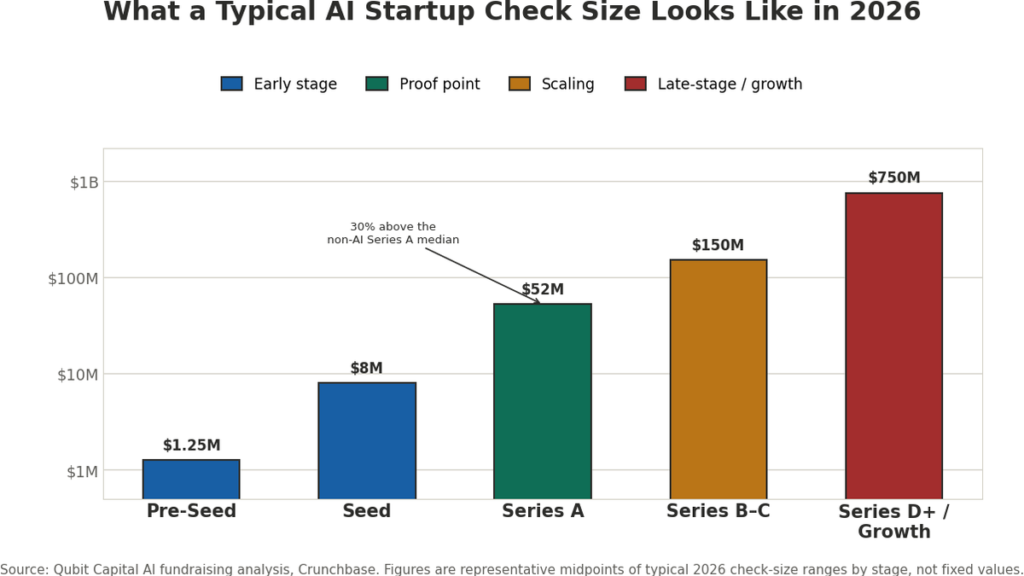
| Stage | Typical Check Size (2026) | What It Signals |
| Pre-Seed | Roughly $500K–$2M | Idea-stage or early prototype; team and problem clarity matter more than traction |
| Seed | Roughly $1M–$15M (wide range in AI) | Early product-market signal; pilots or early paying customers expected |
| Series A | Averaging around $52M for AI companies, well above the non-AI median | Real customers, repeatable sales motion, evidence the product isn’t trivially copyable |
| Series B–C | Tens of millions to several hundred million | Proven growth, expansion into new markets or product lines |
| Series D+ / Growth | Hundreds of millions to billions | Market leadership consolidation, often pre-IPO positioning |
The Series A number is the one worth sitting with. AI startups now average roughly $52M at Series A (well above the typical non-AI benchmark, and about 30% higher according to Qubit Capital’s fundraising analysis) which tells you investors are demanding more proof before that check gets written, not less. The bar for “AI startup” credibility has risen considerably since the earlier wave of generic GPT-wrapper pitches that defined 2023 and 2024.
A company raising a $50M+ Series A today is typically expected to show paying customers, retention data, and some evidence the product can’t be replicated by a competitor with API access to the same underlying models within a few months.
It’s also worth knowing that round labels themselves have gotten less reliable as a signal. “Series A” at one company might mean the same thing “Seed” means at another, especially when a startup raises a large round early to avoid going back to market repeatedly. Read the amount and the investor syndicate together, not the label in isolation.
Where the Money Is Concentrated vs. Where It’s Spreading
Two things are true about 2026 AI funding at the same time, and most coverage only tells you one of them.
The concentration story is real: four companies (OpenAI, Anthropic, xAI, and Waymo) absorbed close to 65% of all global venture capital in Q1 2026 alone, a combined sum near $188 billion. That is not a typo, and it is not normal by any historical comparison. If you zoomed out to look only at the headline total, you’d reasonably conclude the AI funding market is a winner-take-all story playing out at a scale venture capital has never seen. Late-stage funding overall reached roughly $246.6 billion in Q1, up 205% year-over-year, and $235 billion of that went specifically to rounds of $100 million or more.
But the breadth story is also real, and it’s easy to miss underneath the headline number. Early-stage funding (seed and Series A combined) rose a comparatively modest 41% year-over-year in the same quarter, a healthy but far less dramatic increase than the late-stage figure. Strip the four mega-rounds out of the total entirely, and the picture for the remaining 99%-plus of funded startups looks a lot closer to a normal venture year. Over 40% of early-stage AI investment in Q1 2026 went toward $100M+ rounds, yes, but seed and Series A activity kept moving at a healthy clip beneath that.
Geography tells a similar two-track story. The United States captured around 81% of global venture investment in Q1 2026, up sharply from 55% a year earlier, almost entirely a function of where the mega-rounds happened to be headquartered, since OpenAI, Anthropic, xAI, and Waymo are all San Francisco Bay Area companies. China held its position as the second-largest market at roughly $16 billion, despite ongoing export controls on advanced AI chips constraining what Chinese AI infrastructure companies can build.
Europe’s AI-specific funding actually grew faster in percentage terms than the US figure (up nearly 30% year-over-year, with AI claiming more than half of all European venture funding for the first time in Q1 2026) even though the absolute dollar totals remain far smaller. That’s not a market starved for capital outside the mega-deals. It’s a market where the available capital sorts itself unusually sharply by both stage and geography.
The practical takeaway, if you’re a founder benchmarking your own raise: don’t measure yourself against the $122B headline. Measure against the Series A median for your actual stage, sector, and region, because that number tells you something real about what investors expect right now, and the $122B number tells you almost nothing about your situation at all. The same logic applies if you’re a job seeker trying to read funding announcements as hiring signals, a $250M Series D at a company you’ve never heard of is a much stronger hiring signal, proportionally, than a multi-billion-dollar mega-round at a company that already has thousands of employees.
What’s Next, IPOs and the Second Half of 2026
The AI funding story is starting to spill over into public markets, and that shift changes the calculus for everyone still raising privately.
Cerebras went public on May 14, 2026, raising $5.55B at a $95B market cap and gaining 68% on its first day of trading, a strong signal that public investors are hungry for AI infrastructure exposure, not just private VCs. SpaceX’s roadshow began June 8, targeting a $1.75 trillion debut if the xAI-SpaceX combined entity proceeds as planned, which would be the largest public offering in history by a wide margin.
OpenAI is reportedly preparing its own listing, expected in the second half of 2026, which would test public-market appetite for a frontier AI lab at a valuation north of $1 trillion. Anthropic, for its part, closed a $65 billion Series H in late May at a $965 billion post-money valuation and then confidentially filed for an IPO of its own, according to Bloomberg, overtaking OpenAI’s last private valuation and potentially beating it to a Wall Street debut as soon as this fall.
For earlier-stage companies, this matters more than it might seem. A healthy AI IPO market gives late-stage investors a credible exit path, which in turn makes them more willing to write the big growth-stage checks that eventually trickle down into more aggressive seed and Series A investing.
When the exit market is closed, growth investors get conservative, and that conservatism works its way backward through the entire funding stack, Series C investors get pickier because they can’t be sure of their own exit, Series A investors get pickier because they’re not sure Series C will materialize, and so on. An open IPO window does the opposite: it loosens capital at every stage behind it.
Watch the IPO pipeline over the next two quarters. It’s a leading indicator for how loose or tight earlier-stage AI funding will feel heading into 2027, and it will likely matter more to the broader funding environment than any single mega-round announcement between now and year-end.
The Bottom Line
2026’s AI funding story isn’t one trend, it’s two running in parallel. A handful of frontier labs are absorbing record-breaking capital at a scale with no precedent, while a quieter, more disciplined market for seed and Series A deals keeps moving underneath it. If you’re tracking this space, watch both layers, not just the headline number.
FAQ
What counts as a “recently funded” AI startup?
This article covers companies that closed a disclosed institutional funding round during 2026, verified by at least one primary or major financial news source, where AI is the company’s core product rather than an added feature.
How much funding have AI startups raised in 2026 so far?
AI startups captured roughly $242 billion in Q1 2026 alone (about 80% of all global venture capital that quarter) driven heavily by four mega-rounds: OpenAI, Anthropic, xAI, and Waymo.
What’s the difference between a seed round and a Series A?
Seed funding backs early product-market signal, often pre-revenue or pre-scale. Series A requires demonstrated traction (paying customers and repeatable sales) and now averages around $52M for AI companies specifically.
Are AI startup valuations inflated?
Some are. Mega-round concentration at the top reflects genuine scarcity value for a few category leaders, but seed-stage AI valuations carry a documented premium over non-AI peers that not every company will grow into.
Where can I track new AI funding announcements?
Crunchbase’s Megadeals board, PitchBook, and direct reporting from TechCrunch and Reuters are the most reliably updated sources; most aggregator lists (including this one) draw from the same underlying primary reporting.