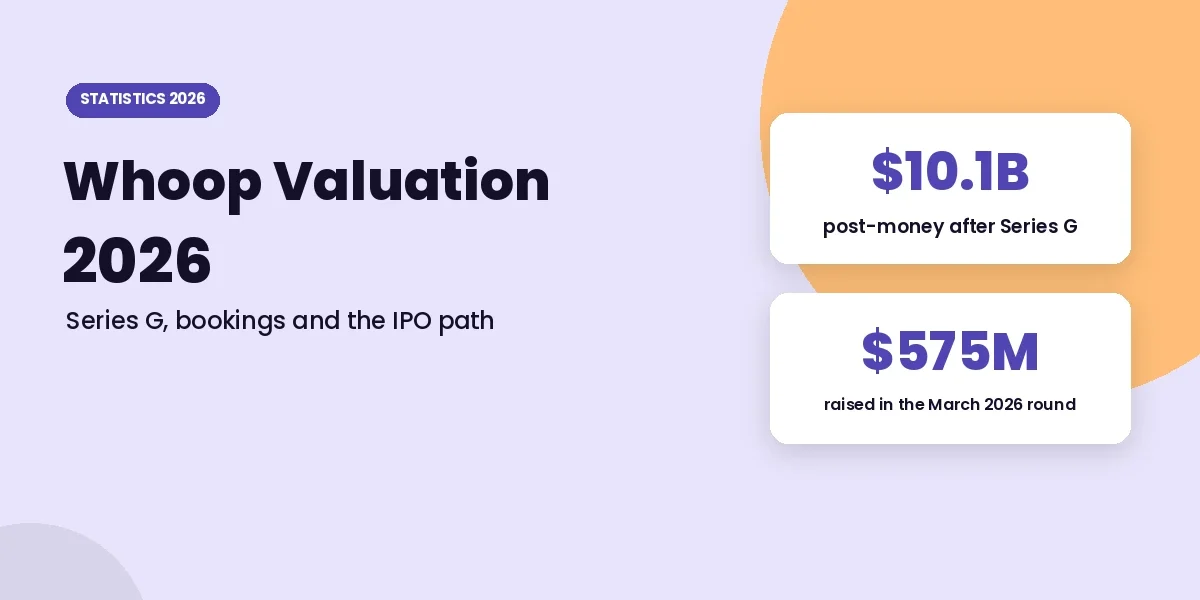
Whoop is valued at $10.1 billion, the post-money valuation from a $575 million Series G round the company announced on March 31, 2026, as reported by TechCrunch, Bloomberg and The Wall Street Journal. That’s the latest figure; Whoop is still private, and no newer priced round had been announced as of November 11, 2026.
The jump was steep. Whoop’s previous priced round, in 2021, valued it at $3.6 billion. Here’s what changed in between, and what the number does and doesn’t tell you.
Whoop’s Series G at a glance
Collaborative Fund led the round. Other participants included Mubadala, Qatar Investment Authority, 2PointZero Group, Abbott, Mayo Clinic, Macquarie Capital and returning backers IVP and Foundry Group, according to TechCrunch’s report on the round. Athletes including Cristiano Ronaldo, LeBron James and Rory McIlroy also invested.
TechCrunch put Whoop’s total funding at roughly $900 million since its founding in 2012. The investor mix matters more than the celebrity names: Abbott and Mayo Clinic signal Whoop’s push from fitness tracking into medical-grade health features.
Whoop valuation history
| Date | Event or round | Amount raised | Valuation | Lead investors | Source |
|---|---|---|---|---|---|
| Oct 2020 | Series E | $100M | $1.2B (disclosed) | IVP | Whoop announcement |
| Aug 2021 | Series F | $200M | $3.6B (disclosed) | SoftBank Vision Fund 2 | Whoop press release |
| Mar 31, 2026 | Series G | $575M | $10.1B (disclosed) | Collaborative Fund | Whoop, TechCrunch, Bloomberg, WSJ |
You’ll see lower figures on some data sites, such as a $7.4 billion “current valuation” on Tracxn. Those come from the provider’s own models, not from a transaction, so they aren’t comparable to a priced round.
What drives Whoop’s $10.1 billion price
Whoop sells memberships, not devices. The strap comes included, and a standard annual membership cost $239 in early 2026, according to Yahoo Finance. That subscription model is why investors value it more like a software company than a gadget maker.
CEO Will Ahmed told TechCrunch the company exited 2025 at a $1.1 billion bookings run rate, up 103% year over year. Bloomberg reported that Whoop had more than 2.5 million members and was cash-flow positive in 2025.
Bookings aren’t revenue. Bookings count the value of memberships sold, often paid upfront, while revenue is recognized over the membership period. Ahmed argued bookings better capture the cash dynamics of a business that ships hardware and sells subscriptions at once.
The bookings multiple, and how it compares with Oura
As an illustrative calculation only: $10.1 billion divided by the $1.1 billion bookings run rate gives a multiple of about 9 times. Because bookings usually run ahead of recognized revenue for a growing subscription business, the revenue multiple would be somewhat higher.
The closest comparison is Oura, the smart ring maker. Yahoo Finance reported that Oura raised $900 million at an $11 billion valuation in October 2025, which leaves Whoop’s newer mark slightly below its main rival’s older one. Investors are pricing the two as near-equals in the subscription health wearable category.
Four and a half years passed between Series F and Series G with no new priced round. Sources: Whoop, TechCrunch.
Is Whoop worth more after the long gap between rounds?
It’s worth noticing how long Whoop went without a priced round. Plenty of 2021-era companies raised at peak valuations and later cut their price. Whoop waited, grew bookings, reached positive cash flow and then raised at nearly three times its old mark. That’s the opposite of a down round.
Waiting is a strategy more founders could use. If you’re weighing whether to raise now or build first, our piece on bootstrapped fundraising strategy covers how traction changes your negotiating position.
Risks behind the number
The Wall Street Journal’s headline on the round noted Whoop raised “despite FDA rift.” The FDA had warned Whoop in 2025 that its blood pressure feature needed clearance, and Whoop declined to pull it. Regulatory friction is a real risk for a company betting on health features.
Competition is another. Apple, Garmin, Samsung and Oura all chase the same customer, and wearable demand is tied to consumer spending. For a wider view of how health tech companies are using AI and data, see our AI in healthcare statistics.
When will Whoop go public?
Ahmed told Bloomberg in August 2026 that Whoop is on track for an IPO in roughly 18 months, which points to early 2027 at the soonest. The Boston Globe reported the company plans to roughly double its Boston headquarters ahead of a listing. No IPO filing has been made public.
Want to see which other companies closed large rounds this year? Our list of recently funded startups tracks them.
FAQ
Can you buy Whoop stock?
Not on a public exchange. Whoop is privately held, so its shares aren’t listed. Accredited investors can sometimes buy private shares through secondary platforms, but prices there vary and liquidity is limited. Most people will have to wait for an IPO, which Whoop has signaled for around 2027.
Who founded Whoop?
Will Ahmed founded Whoop in 2012 while at Harvard, along with co-founders John Capodilupo and Aurelian Nicolae. Ahmed remains CEO. The company is based in Boston and grew from a performance tracker for elite athletes into a consumer health membership business.
Whoop’s $10.1 billion is a clean, disclosed number from a priced round, which is rarer than it sounds. Whether it holds up depends on the public market’s verdict, and that verdict may arrive within the next 18 months.