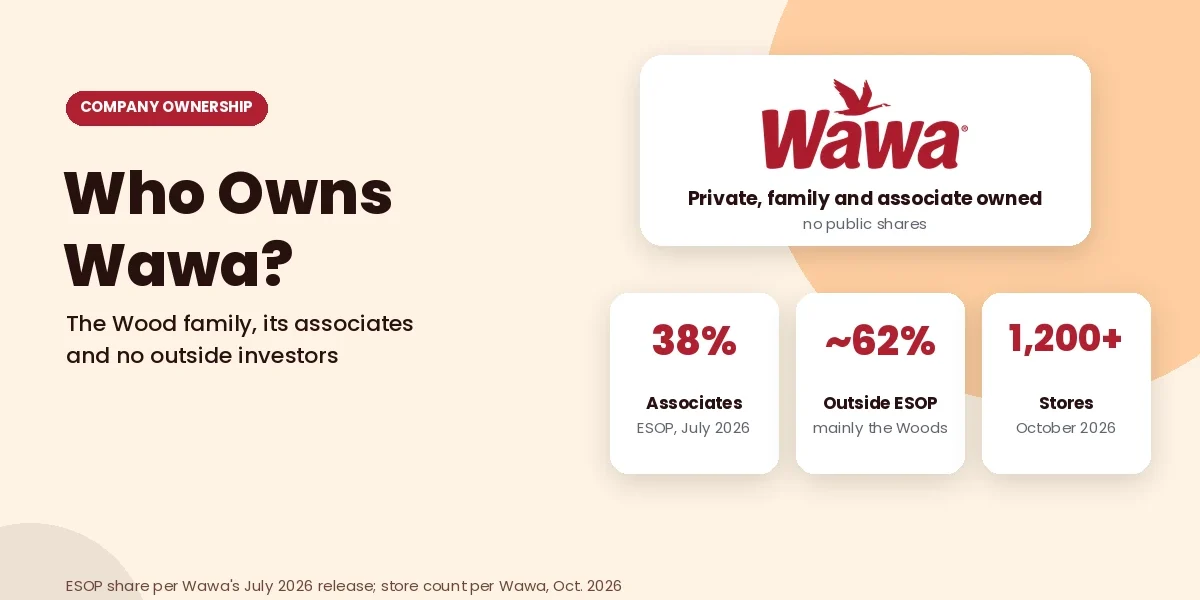
Wawa is owned by the Wood family and its own employees. The convenience chain is privately held with no public shares, and Wawa said in July 2026 that its associates own 38% of the company through an employee stock ownership plan (ESOP). The rest sits outside the ESOP, largely with the founding Wood family, though Wawa doesn’t publish the family’s exact percentage.
You’ll often see a tidy 59/41 split quoted for family and employees. Wawa’s own recent statements put the employee side a little lower, and the gap is worth a closer look.
How Wawa’s ownership splits
Wawa ownership, 2026 (approximate)
The ESOP share is Wawa’s own figure (38%, July 2026 release). The remainder is held outside the plan, mainly by the Wood family; Wawa doesn’t itemize it.
In February 2026, Wawa described itself as a family and associate owned, privately held company. Its careers page says the ESOP owns approximately 38% of the company, while its 2025 and 2026 expansion announcements say almost 39%.
| Year | ESOP stake stated | Where it was stated |
|---|---|---|
| 2003 | About 8% | Hagley Museum and Library history of the buyout |
| 2012 | 37% | Wawa’s 20th ESOP anniversary announcement |
| 2023 | 39% | Wawa’s Ohio, Indiana and Kentucky expansion releases |
| January 2025 | Almost 39% | Wawa Ohio hiring update |
| 2026 | Approximately 38% to almost 39% | Wawa careers page; Tennessee opening release (May 2026); Wawa release on Dick Wood Jr. (July 2026) |
Sources: Wawa press releases and careers page; Hagley Museum and Library (2016).
The 41% figure that many articles repeat matches an older Wawa hiring announcement from when the chain had just over 700 stores, not its current materials. Wawa’s board also decides each year how much, if anything, to contribute to the ESOP, so the percentage can move. Treat 38%, Wawa’s latest figure (July 2026), as today’s answer.
How the Wawa ESOP works
Associates don’t buy in. Wawa says the ESOP comes at no cost, on top of a 401(k) match. Associates aged 18 or older who meet the plan’s other rules become eligible on the first day of the month after they’re hired, and they qualify for a contribution in any year they work 1,000 hours.
Because there’s no public stock, getting hired is the only route to owning a piece of Wawa. Wawa calls the ESOP a pillar of its culture; if you’re comparing how companies turn stated values into structure, Apple’s core values make a useful contrast, since Apple pairs strong values language with ordinary public ownership.
The 2003 decision that kept Wawa private
Wawa came close to public ownership once. According to the Hagley Museum and Library, a plan that would have moved the company toward going public was scuttled by then-president Dick Wood in July 2003, at a meeting with the investment banks lined up for an IPO.
Wood then negotiated to buy the outside shares held by Fidelity Bank, at a cost of $141 million, according to Hagley’s 2016 account. In December 2003, Wawa said it would make much more stock available to employees to help fund the purchase, and by March 2004, 70% of employees had shifted part of their 401(k) and profit-sharing savings into the ESOP, which had held about 8% before.
That’s where today’s split comes from: a family that refused to sell and employees who helped pay for the buyout. It’s close to the opposite of the venture model, where outside investors fund growth in exchange for equity; our Silicon Valley startups guide shows that path.
Who is the current CEO of Wawa?
Chris Gheysens is Wawa’s chairman and CEO. He took over as CEO in January 2013, succeeding Howard Stoeckel, and Brian Schaller serves as president.
The family’s best-known executive, Richard “Dick” Wood Jr., led Wawa as president, CEO and chairman for decades. He died on July 10, 2026, at 88, Wawa announced.
What nationality is the owner of Wawa?
American. The Wood family business began as an iron foundry in New Jersey in 1803, moved into dairy with a processing plant in Wawa, Pennsylvania, in 1902, and opened the first Wawa Food Market in 1964 under Grahame Wood, George Wood’s grandson. The company is headquartered in Chester Heights, Pennsylvania, and its owners are the Wood family and Wawa’s own associates.
What does Wawa stand for?
It isn’t an acronym. The chain is named after Wawa, Pennsylvania, where the family’s dairy plant opened in 1902. The word is generally traced to a Native American word for a wild goose (Longfellow used “Wawa” for the wild goose in his 1855 poem The Song of Hiawatha), which is why a Canada goose sits in the logo.
Who is bigger, Wawa or Buc-ee’s?
Wawa, by a wide margin on store count. Wawa reported more than 1,200 locations in October 2026, with nearly 100 openings planned across 14 states this year. Buc-ee’s had more than 60 travel centers across about a dozen states in 2026, according to Nexstar’s reporting, so Wawa has roughly 20 times as many stores.
Forbes estimated Wawa’s revenue at $18.64 billion on its 2025 list of America’s top private companies. Buc-ee’s doesn’t publish revenue. The formats explain the gap: Buc-ee’s builds a few giant highway stops, while Wawa builds neighborhood stores at a much faster pace.
FAQ
Can you buy Wawa stock?
No. Wawa isn’t publicly traded, so there are no shares on any exchange. The only way to own part of the company is through its ESOP, which is open to eligible associates at no cost. The rest is held outside the plan, mainly by the Wood family, and Wawa describes itself as family and associate owned.
Is the first Wawa still open?
No. The first Wawa Food Market opened on April 16, 1964, on MacDade Boulevard in Folsom, Pennsylvania, and closed on June 17, 2016, after 52 years, according to the Hagley Museum and Library. The building that launched the convenience chain is no longer a working store, though plenty of Wawas remain across Delaware County.