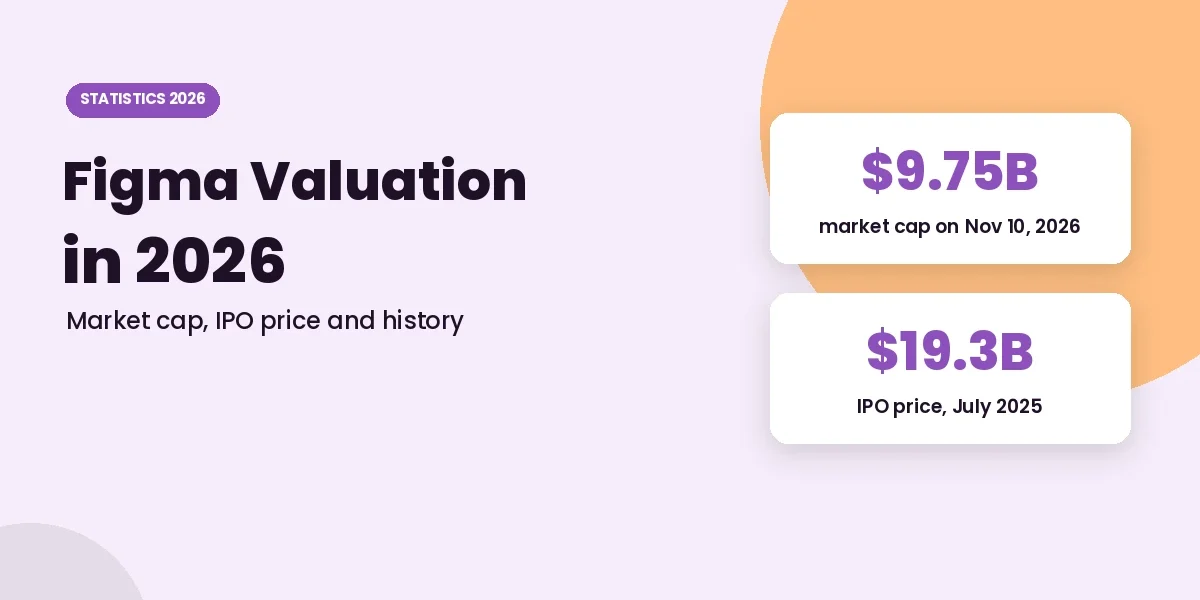
Figma’s valuation was about $9.75 billion on November 10, 2026, measured by stock market capitalization, according to Morningstar’s quote page for NYSE: FIG, with shares trading near $18. That’s a public market cap, not a funding-round price, and it moves every trading day.
The number surprises people because Figma priced its IPO at roughly $19.3 billion in July 2025 and briefly traded above $50 billion. Here’s how it got from there to here, and what the business underneath looks like.
Figma valuation today: market cap, not a funding round
Figma has been a public company since July 31, 2025. Since then its value is set by the share price, not by venture investors. Different data providers show slightly different market caps on the same day because some count only Class A shares while others include Class B shares held mainly by co-founder and CEO Dylan Field.
On November 10, 2026, Morningstar listed about 535.6 million shares outstanding and a market cap of roughly $9.75 billion. A one-dollar move in the share price shifts that by about half a billion dollars, so treat any single figure as a snapshot and check the live quote before you cite it.
This is general information, not investment advice.
Figma valuation history
Figma’s price tag has swung more than most software companies of its size. The table below sticks to disclosed or widely reported transactions.
| Date | Event or round | Amount raised | Valuation | Lead investors | Source |
|---|---|---|---|---|---|
| Jun 2021 | Series E | $200M | $10B (reported) | Not named in sources used; Morgan Stanley’s Counterpoint Global participated | Bloomberg, CNBC |
| Sep 2022 | Adobe acquisition agreement (terminated Dec 2023) | None | $20B deal price (disclosed) | Adobe (buyer) | Adobe, Reuters |
| May to Jul 2024 | Employee and investor tender offer (secondary sale) | $600M to $900M expected tender size; no new money to Figma | $12.5B (disclosed by Figma) | Buyers included Fidelity, Franklin Venture Partners, Coatue, General Catalyst, Alkeon | Reuters, CNBC, Bloomberg |
| Jul 30, 2025 | IPO priced at $33 a share | About $1.2B total offering (reported) | About $19.3B (reported) | Public offering | Reuters |
| Jul 31, 2025 | First trading day close at $115.50 | None | About $56.3B market cap (reported) | Public market | Reuters |
| Nov 10, 2026 | Quoted price near $18 a share | None | About $9.75B market cap | Public market | Morningstar |
One note on the first-day number. Reuters put Figma’s debut-day value at about $56.3 billion, while IFR reported $69.4 billion. The gap comes from share counting: the higher figure uses a fully diluted share count that includes options and restricted stock. Neither is wrong; they measure different things.
Light bars are private-market marks; dark bars are public-market values. Sources: Bloomberg, Adobe, Reuters, Morningstar.
Why did Figma’s stock fall so far after the IPO?
The short version: the first-day price assumed a lot, and the market’s mood toward software turned. Reuters reported Figma shed about $13 billion in market value within days of listing as early buyers took profits.
Through 2026, investors worried that AI coding and design tools could shrink demand for seat-based software. Figma’s results didn’t show that yet, but the stock traded on the fear. After its November 4, 2026 earnings, CNBC reported shares fell about 7% in extended trading even though revenue beat guidance. Morningstar’s analyst pointed to recent pricing and bundle changes that trimmed the operating margin.
What drives Figma’s valuation
The fundamentals are stronger than the share price suggests. Figma’s Q3 2026 results filed with the SEC show revenue of $391.4 million for the quarter ended September 30, up 43% year over year. The company raised full-year 2026 revenue guidance to $1.497 billion to $1.499 billion.
On the Q3 call, management reported a net dollar retention rate of 131%, free cash flow of $41.5 million and $1.7 billion in cash and marketable securities. Full-year 2025 revenue was $1.056 billion, up 41%, per the company’s year-end release.
Morningstar listed Figma’s price-to-sales ratio at about 7.3 on November 10, 2026. The company is now worth less than its $10 billion 2021 private mark, even though it books far more revenue than it did then.
Our read
Figma is a case of a business that kept growing while its multiple collapsed. As an illustrative comparison only: at the IPO price, buyers paid about $19.3 billion for a company with $1.056 billion in 2025 revenue. In November 2026 they paid about $9.75 billion for a company guiding to roughly $1.5 billion. That’s the market repricing software risk, not Figma shrinking.
If you want to see how Figma stacks up against other subscription software names, our list of B2B SaaS companies is a useful reference point.
Is Figma worth more than Adobe offered?
Not right now. Adobe agreed in September 2022 to buy Figma for $20 billion in cash and stock. The deal was called off in December 2023 after pushback from the European Commission and the UK’s Competition and Markets Authority, and Adobe paid Figma a $1 billion termination fee, according to a regulatory filing reported by CNBC.
At about $9.75 billion, Figma’s market cap sits at roughly half the Adobe price. During its first weeks of trading it was worth more than double that offer.
Private rounds vs public market cap: why the numbers don’t compare cleanly
A private valuation is a negotiated price for a small slice of preferred stock, often with investor protections. A public market cap is the last traded price times every share. Figma’s 2024 tender offer at $12.5 billion was also a secondary sale, meaning employees sold existing shares and the company raised no fresh capital.
If those round labels are fuzzy, our breakdown of Series A, B and C funding explains how each stage prices a company. For more Bay Area companies that went from private rounds to public listings, see our guide to Silicon Valley startups.
FAQ
Is Figma a public company?
Yes. Figma listed on the New York Stock Exchange under the ticker FIG on July 31, 2025, after pricing its IPO at $33 per share. Its valuation now comes from the share price rather than private funding rounds, so it changes daily with the market.
How much revenue does Figma make?
Figma reported $1.056 billion in revenue for 2025 and guided to $1.497 billion to $1.499 billion for 2026. Revenue is not the same as valuation: the market cap reflects what investors pay for future earnings, not the sales Figma books in a year.
Who controls Figma?
Co-founder and CEO Dylan Field. Reuters reported in August 2025 that Field held about 74.1% of the voting power through Class B shares, so outside shareholders own a large economic stake but have limited control over company decisions.
Figma’s story so far is simple to state and hard to price: a growing, cash-generating design platform whose value depends on whether investors believe AI widens its market or eats it. The next few earnings reports will settle more of that than any analyst note.