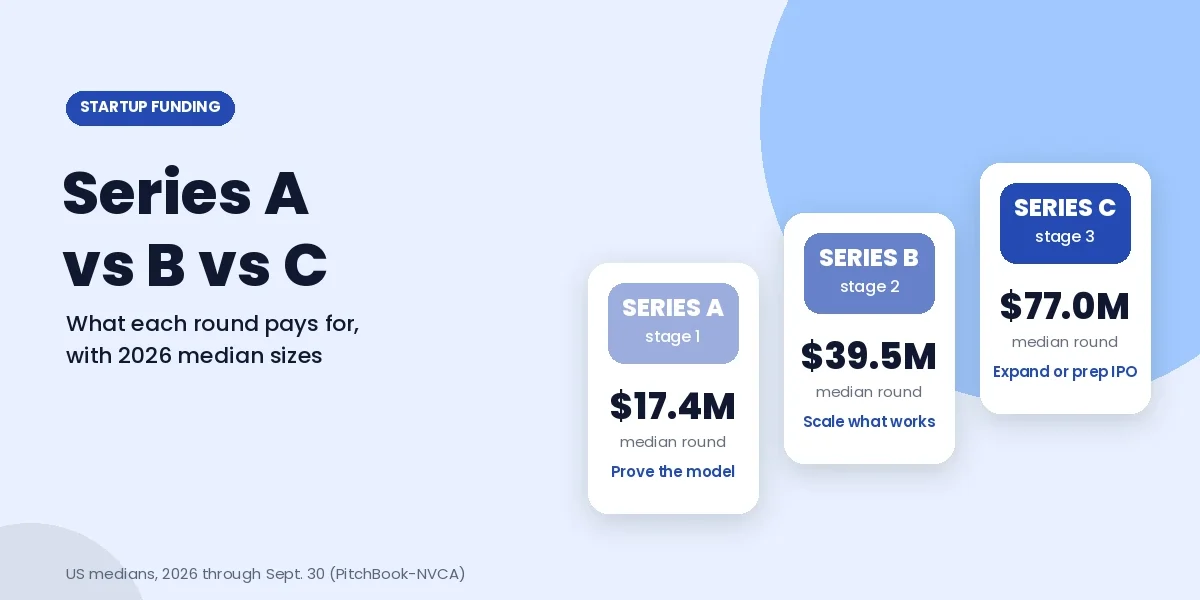
Series A vs B vs C comes down to order and purpose: Series A funds a business model that’s starting to work, Series B pays to scale it, and Series C backs a company that’s already large as it expands, buys competitors or gets ready for an IPO.
Each step is bigger and pricier. PitchBook-NVCA’s US medians for 2026, through Sept. 30, run from $17.4M at Series A to $39.5M at Series B and $77.0M at Series C.
Key takeaways
The full sequence, from seed to Series D and beyond
The letters are simply the order of priced rounds, with no size rules attached. PitchBook, whose data powers the NVCA’s quarterly Venture Monitor, groups Series A and B as early stage, C and D as late stage, and Series E onward as venture growth.
Here’s how each stage looks in one dataset, so the rows compare cleanly.
| Stage | Typical purpose | Median deal | Median pre-money | Share sold (our calc) |
|---|---|---|---|---|
| Seed | Product and first customers | $3.0M | $18.3M | ~14% |
| Series A | First real go-to-market push | $17.4M | $60.3M | ~22% |
| Series B | Scaling sales, hiring, new segments | $39.5M | $187.0M | ~17% |
| Series C | Expansion, acquisitions, IPO prep | $77.0M | $500.0M | ~13% |
| Series D and later | Late expansion or pre-IPO runway | $150.0M | $1,723.7M | ~8% |
Source: PitchBook-NVCA Venture Monitor, Q3 2026, US deals through Sept. 30, 2026. “Share sold” is our rough calculation (median deal divided by median pre-money plus median deal), not reported dilution.
Two patterns stand out. Rounds keep getting bigger, but the share of the company sold peaks around Series A and shrinks from there, because prices climb faster than check sizes.
The jump between stage medians looks steep: about 3.1x in median pre-money valuation from A to B and 2.7x from B to C on these numbers. That compares different companies, though. Tracking the same companies round to round, PitchBook’s 2026 median valuation step-up was 2.2x for AI startups and 1.5x for everyone else.
Our read: plan around the step-up, not the gap between medians. A non-AI company raising its next round at 1.5x its last price is doing about normal for 2026, even if that looks small next to the table.
Series A vs B vs C: what each round pays for
Series A: a model that works
The company has a product and early revenue, and the round funds its first serious sales and marketing push. Lead investors are usually early-stage venture firms betting on the team and the market.
Series B: a repeatable machine
The model works, so the money goes into hiring, more channels and new customer segments. Investors want proof that spending turns into growth on a predictable schedule.
Series C: scale, acquisitions or an exit plan
By C, the company is buying growth: new countries, new product lines, acquisitions, or the finance and governance work an IPO needs.
The investor mix widens too. Later-stage VCs and growth funds lead most rounds, and crossover investors such as hedge funds, mutual funds and sovereign wealth funds appear in the biggest ones. PitchBook counted crossover participation in 43% of 2026 megadeals, down from 60% in 2021.
How long it takes to get from seed to Series C
Longer than most founders plan for. Carta’s analysis of more than 31,000 primary rounds since 2015 found the average company was 6.9 years past incorporation when it raised a Series C in 2023.
Average years from incorporation to each round (2023)
Source: Carta, published Feb. 2024; Series E+ combines several rounds.
The gaps widened after that. Carta’s end-2024 medians were 2.2 years from seed to A, 2.5 years from A to B and 2.4 years from B to C. Added together, that’s about seven years from seed to C (our sum of medians, so a rough guide).
They have started to shrink since. Carta’s Q1 2026 report puts the median at “an even two years” from seed to Series A, 2.1 years from A to B and 2.4 years from B to C, about six and a half years in total (State of Private Markets Q1 2026, May 29, 2026). Still, planning for six to seven years from seed to C is safer than counting on the old 18-month cycle.
Is Series C still a startup?
Legally and financially, yes: it’s still private and venture-backed. In practice, a company raising a C is often around seven years old, has a proven business and carries PitchBook’s late-stage label.
Many stay private far longer. PitchBook counted 992 active US unicorns as of Sept. 30, 2026, worth a combined $5.7 trillion.
Is Series B risky, and is Series C funding good?
Is Series B risky?
Yes, though the risk changes shape. At B the product question is mostly answered, and the open question is whether growth holds up at a much higher price.
Carta found in March 2026 that the share of startups reaching their next round within two years barely improves from seed to A to B, so moving up a letter doesn’t buy much safety. Getting there is rare in itself: Carta’s May 2025 data showed only about 20% to 23% of seed companies reach Series B within six years.
Is Series C funding good?
For the company, usually. Late-stage investors don’t write checks near the $77.0M median without strong numbers. The catch is price: a big C valuation sets the bar for every round and exit after it.
Miro shows how that plays out. Bending Spoons completed its purchase on Oct. 26, 2026 at a $1.36 billion enterprise value, against a $17.5 billion Series C valuation in 2022.
The same report cites Forge data showing shares in companies that last raised in 2021 trading at a median 59% discount, and 45% for 2023 raisers. If you’re buying late-stage shares on a secondary platform, that’s the risk to price in.
What comes after Series C: D, E, F and beyond
The letters keep going for as long as a company raises priced private rounds. A Series D can mean a pre-IPO push or simply more runway, and from Series E PitchBook treats the company as venture growth.
Those rounds have ballooned. PitchBook’s 2026 median Series D-and-later pre-money valuation was $1,723.7M, more than double 2025’s $831.9M. AI drives most of it, taking 82.7% of US venture deal value through Sept. 30, and our list of 2026’s biggest AI rounds shows where that money landed.
Some companies go many rounds past C and stay private. PitchBook estimated Databricks at $198.2 billion (Aug. 13, 2026) on $29.2 billion raised, and Anduril at $70.4 billion (May 13, 2026) on $11.9 billion; our defense startups overview puts Anduril in context.
Late rounds aren’t only a coastal story. About 70% of venture-growth deals by count in Q3 2026 happened outside San Francisco and New York, per PitchBook, which is worth knowing if you’re building in a market like Dallas.
Class A vs Class C shares: a different question
“Should I buy Class A or C shares?” is about stock classes, not funding rounds, and the answer depends on which kind you mean.
At Alphabet, Class A shares (GOOGL) carry one vote each and Class C shares (GOOG) carry none. If voting doesn’t matter to you, the two are otherwise similar claims on the same company.
For mutual funds, the SEC’s investor bulletin (updated February 2021) says Class A shares usually charge a front-end sales load, with discounts for larger purchases, and lower ongoing 12b-1 fees. Class C shares skip the front load but carry higher 12b-1 fees and a charge if you sell within about a year, so holding them for many years can cost more. Check the fund’s prospectus for its actual fees.
Other questions
How is seed funding different from Series A?
Seed comes first and is much smaller, often raised through SAFEs or convertible notes that turn into shares later. PitchBook’s 2026 median US seed deal was $3.0M at an $18.3M pre-money valuation, against $17.4M at $60.3M for Series A, which is usually the first priced round.
Does a company need a Series C before an IPO?
No. A company can go public or sell after any round if its numbers and the market allow it. Many raise several later rounds first because public investors expect scale that takes years to build, but there’s no rule that a C, D or E has to come before a listing.
Think of the letters as a rough clock rather than a scorecard. A buys proof, B buys a machine, C buys scale, and on recent Carta data each one takes more than two years to earn the next.