
Here’s the SWOT analysis definition that planning agencies such as the US EDA share: a SWOT analysis is a planning tool that lists an organization’s internal strengths and weaknesses alongside the external opportunities and threats it faces, usually in a 2×2 grid, so decisions start from an honest picture of where it stands.
It works for a company, a product, a region or a single person. The acronym is the easy part. Sorting each item into the right box, and then doing something with the grid, is where most attempts fall short.
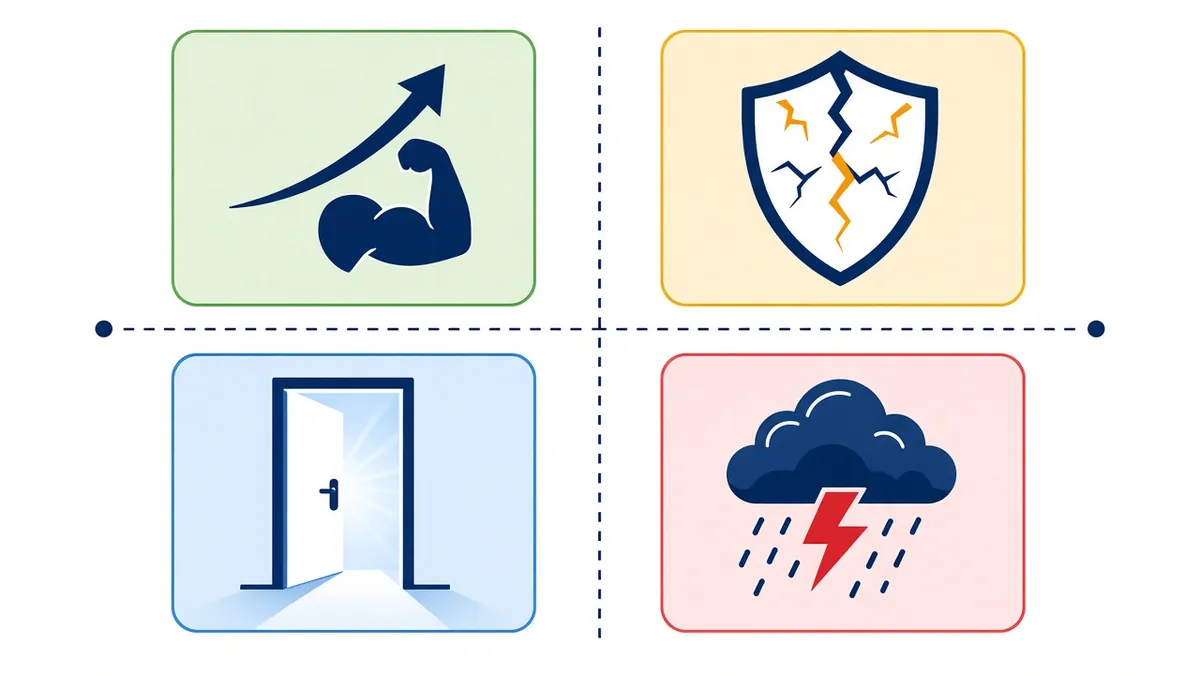
What you do well and control
Gaps and limits you control
Outside trends you could use
Outside forces that could hurt you
The SWOT grid: two internal boxes on top, two external boxes below.
SWOT analysis definition: what best defines it?
The internal-versus-external split. The US Economic Development Administration’s SWOT guidance describes strengths and weaknesses as usually internal, and opportunities and threats as usually external.
A quick test: if you control it, it’s internal. A new rival entering your market is a threat, not a weakness. Your slow product releases are a weakness, even if that rival makes them hurt more.
5 examples of weaknesses in a SWOT analysis
Weaknesses are the box people fill most vaguely. Specific ones look like this:
- Less than a year of cash runway
- More than half of revenue coming from one customer
- Nobody on the team owns sales
- Low brand awareness outside one city
- Manual processes that break as order volume grows
A good SWOT analysis example
Here’s a hypothetical example for a bootstrapped software startup selling booking tools to independent gyms. It’s an illustration, not a real company.
| Box | Entries for the gym software startup |
|---|---|
| Strengths | Founders ran gyms themselves; a small base of paying customers who refer others |
| Weaknesses | One developer; no sales hire; limited cash runway |
| Opportunities | Gyms moving off spreadsheets; a payments company offering partner referrals |
| Threats | Larger software vendors adding the same features; gym closures in a downturn |
Notice what’s missing: “great team” and “growing market.” Entries that would fit any business don’t help you decide anything.
For practice on a real brand, try sorting the moves in our Nescafé marketing strategy breakdown into the four boxes.
What are the four SWOT strategies?
A finished grid doesn’t tell you what to do. The four SWOT strategies come from the TOWS matrix, which management professor Heinz Weihrich published in Long Range Planning in 1982. It pairs internal and external boxes to generate options.
| Strategy | Logic | Move for the gym startup |
|---|---|---|
| SO (strengths-opportunities) | Use strengths to grab opportunities | Sell through the payments partner, using the founders’ gym credibility |
| WO (weaknesses-opportunities) | Use opportunities to fix weaknesses | Let partner referrals stand in for the missing sales hire |
| ST (strengths-threats) | Use strengths to blunt threats | Build gym-specific features big vendors won’t bother with |
| WT (weaknesses-threats) | Shrink exposure where both hit | Push annual plans to protect runway if gyms close |
Founders planning a cloud startup can run the same pairing before writing a pitch deck.
Who created SWOT analysis?
Not the person most websites name. The best documented account comes from Richard Puyt and Finn Birger Lie, with Celeste Wilderom (2023) and Dag Øivind Madsen (2025), who traced the tool through archives and interviews in Journal of Management History (2025) and Long Range Planning (2023). Their reconstruction, in order:
- 1965: A research group at SRI (Stanford Research Institute) led by Robert F. Stewart developed the “SOFT” approach: satisfactory, opportunities, faults, threats. Managers graded their key planning issues as safeguarding strengths, opening opportunities, fixing faults or thwarting threats.
- 1966-67: SOFT was tested in SRI executive seminars, and the four SWOT terms first appeared together in a formal-planning text, SRI LRPS Report 329 by Igor Ansoff and Stewart (1967), where the method was still called “gap analysis.”
- 1972: A paper by Stait used “SWOT analysis” in its title.
- 1974: John Argenti’s Systematic Corporate Planning showed the 2×2 cross-shaped grid most people picture today.
- 1982: Weihrich added the TOWS matrix for turning the grid into strategies.
Two common attributions don’t hold up as well. Albert Humphrey is often called the inventor; he was part of the SRI team, but the claim that he coined SWOT rests mostly on his own 2005 letter, the researchers found. Harvard’s 1965 Business Policy textbook by Learned, Christensen, Andrews and Guth is also credited, including by strategy scholar Pankaj Ghemawat in Business History Review (2002), but Puyt’s team checked Harvard’s 1963 business policy symposium and consulted co-author William Guth, then rejected it as the tool’s source.
Where SWOT falls short
My take: SWOT is a sorting exercise, not a strategy. Its weak spots are predictable. The grid doesn’t rank items, so a minor strength sits beside a fatal weakness, and it’s a snapshot that goes stale as markets move.
The fix is simple. Rank the top three entries in each box, attach evidence to each one, and finish with TOWS moves you’d actually fund. That’s also how it holds up in market-entry planning, such as the licensing and setup choices in our guide to starting a business in Dubai.
FAQ
Can you do a SWOT analysis of yourself?
Yes. Strengths and weaknesses become your skills, habits and track record, while opportunities and threats come from your industry, employer or job market. A personal example: strong writing skills, weak public speaking, a growing demand for content roles, and AI tools reducing entry-level writing work. Keep each entry specific and provable.
Is there a standard SWOT analysis template?
The standard template is the 2×2 grid shown near the top of this page: strengths and weaknesses across the internal row, opportunities and threats across the external row. Any spreadsheet or whiteboard works. What matters more than the template is ranking entries and following up with SO, WO, ST and WT strategies.