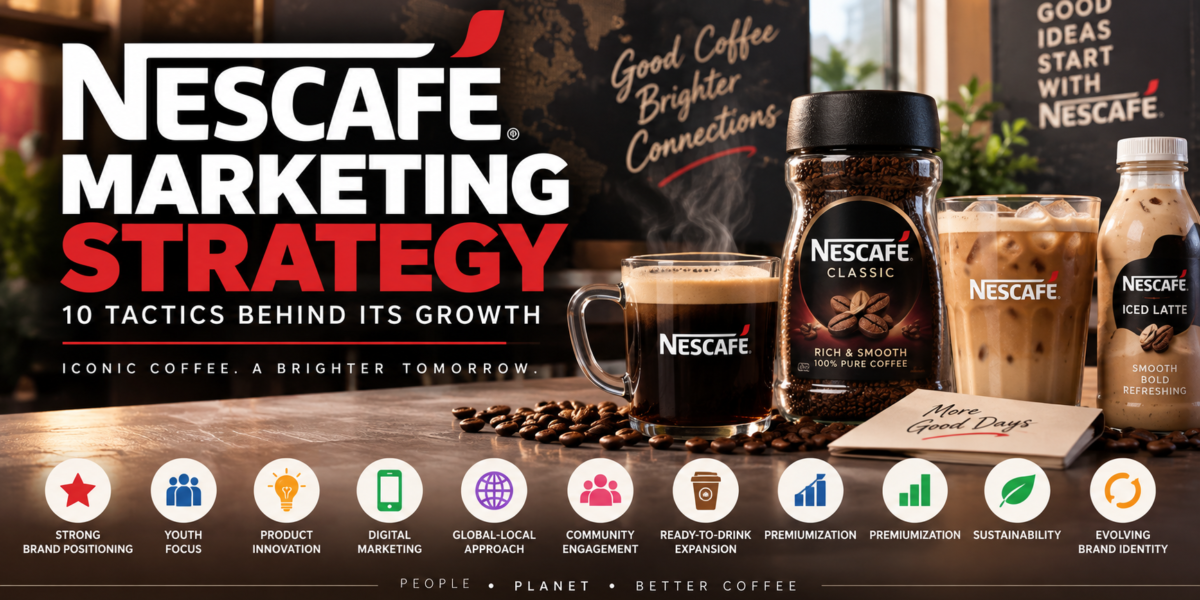
Nescafé’s marketing strategy combines mass-market accessibility, product innovation, digital-first promotion, youth-focused branding, localized campaigns, premiumization, and sustainability. Rather than leaning only on its heritage as one of the world’s best-known instant coffee brands, Nescafé’s marketing strategy increasingly sells coffee around occasions, lifestyles, convenience, personalization, and social experience.
In This Article
- What Is Nescafé’s Marketing Strategy?
- 1. Global Brand Positioning Anchors Nescafé’s Marketing Strategy
- 2. Younger Consumers Are Central to Nescafé’s Marketing Strategy
- 3. Product Innovation Expands Nescafé’s Marketing Strategy Into New Occasions
- 4. Nescafé’s Marketing Strategy Has Shifted to Social-First Promotion
- 5. Influencer Marketing Strengthens Nescafé’s Marketing Strategy With Gen Z
- 6. Nescafé Markets Through Culture and Online Communities
- 7. Global Strategy, Local Execution
- 8. Ready-to-Drink Coffee Extends Nescafé’s Marketing Strategy Beyond the Home
- 9. Premiumization Raises the Value of Nescafé’s Marketing Strategy
- 10. Sustainability Is Now Core to Nescafé’s Marketing Strategy
- Nescafé’s Marketing Mix: The 4Ps Behind the Strategy
- How Nescafé’s Marketing Strategy Has Evolved
- Why Nescafé’s Marketing Strategy Works
- Final Takeaway
- Frequently Asked Questions About Nescafé’s Marketing Strategy
The strategy is particularly focused on recruiting younger consumers. Nestlé says younger generations are increasingly entering the coffee category through cold coffee, and Nescafé has expanded products such as Espresso Concentrate and ready-to-drink coffee specifically to address these changing consumption habits.
This mix of global scale and constant adaptation is why Nescafé remains one of Nestlé’s most important brands, and why its marketing playbook is worth studying closely.
What Is Nescafé’s Marketing Strategy?
Nescafé’s marketing strategy can be summarized around ten connected pillars.
| Strategy | How Nescafé Uses It |
| Brand positioning | Makes coffee convenient, accessible, and relevant to everyday life |
| Targeting younger consumers | Cold coffee, creators, gaming, and social-media campaigns |
| Product innovation | Espresso Concentrate, ready-to-drink coffee, and premium formats |
| Digital marketing | TikTok, Instagram, influencers, and creator-led content |
| Global-local approach | A consistent brand identity paired with market-specific campaigns |
| Culture and community marketing | Gaming, streaming, and niche online communities |
| Ready-to-drink expansion | New cold-coffee formats for on-the-go consumption |
| Premiumization | Café-style experiences and higher-value products such as Nescafé Gold |
| Sustainability | The Nescafé Plan 2030 and regenerative agriculture initiatives |
| Evolving brand identity | A history of reinvention, from 1938 instant coffee to today’s cold-coffee push |
Together, these pillars let Nescafé’s marketing strategy defend its traditional instant-coffee business while entering faster-growing corners of the wider coffee market.
1. Global Brand Positioning Anchors Nescafé’s Marketing Strategy
Nescafé launched in Switzerland in 1938 after Nestlé developed a soluble coffee product to help absorb Brazil’s coffee surplus. It has since expanded around the world and become one of Nestlé’s flagship brands, now sold in more than 180 countries.
A defining moment in Nescafé’s marketing strategy arrived in 2014 with what Nestlé called the “REDvolution.” For the first time, Nescafé introduced a unified global visual identity across products sold in roughly 180 markets, alongside the global slogan “It all starts with a Nescafé.”
The goal was simple: consumers should recognize Nescafé consistently whether they encounter it in Europe, Asia, Latin America, or anywhere else. That global consistency still gives Nescafé’s marketing strategy strong brand recognition today, while local teams retain room to tailor specific products and campaigns.
2. Younger Consumers Are Central to Nescafé’s Marketing Strategy
One of the clearest shifts in Nescafé’s current marketing strategy is its focus on Gen Z and younger Millennials. Nestlé reports that younger generations are increasingly entering the coffee category through cold coffee, with roughly two out of three young consumers drinking cold coffee regularly, and about a third of coffee consumed outside the home now served cold.
Nescafé has responded by building products and campaigns around these habits. Its Espresso Concentrate, launched in May 2024, had reached 15 countries by 2025. Consumers use the concentrate to make personalized iced drinks, such as iced lattes and other café-style beverages, without specialist equipment.
Nestlé has said explicitly that it wants to turn 18-to-24-year-olds into coffee concentrate consumers, reaching them online through the creators they already follow. That makes demographic recruitment, not just selling more coffee to existing buyers, a central part of Nescafé’s marketing strategy.
3. Product Innovation Expands Nescafé’s Marketing Strategy Into New Occasions
Nescafé is no longer marketing only the convenience of traditional instant coffee. The company is working to increase the number of situations in which consumers choose the brand. Products across the portfolio now cover:
- Traditional instant coffee
- Premium instant coffee
- Cappuccino and espresso-style products
- Cold coffee
- Ready-to-drink beverages
- Coffee concentrates
- Café-style drinks prepared at home
This range supports Nestlé’s broader coffee strategy of driving growth through premiumization, attracting new consumers, and creating additional coffee-drinking occasions. Espresso Concentrate is the clearest example: instead of competing purely against another jar of instant coffee, it lets Nescafé’s marketing strategy compete for occasions that might otherwise involve a café visit, a homemade iced drink, or a ready-to-drink product. Nestlé has said the innovation is projected to generate more than CHF 100 million in annual global sales in the coming years, underlining how much commercial weight sits behind the cold-coffee push.
4. Nescafé’s Marketing Strategy Has Shifted to Social-First Promotion
Digital media is increasingly central to Nescafé’s marketing strategy. This isn’t new: in 2015, Nescafé became the first global brand to move its international and local websites onto Tumblr, part of an early effort to build stronger relationships with younger consumers. At the time, Nestlé described Nescafé as its best-performing brand on social media, with more than 35 million fans worldwide.
The platforms have changed, but the direction hasn’t. Today, the emphasis sits on channels such as TikTok and Instagram, where visual coffee recipes, customization, and creator culture fit naturally with Nescafé’s cold-coffee products. Nestlé is reshaping its wider marketing organization for what it calls a digital, social-first media landscape, backed by content creation, analytics, data, and ROI measurement. For Nescafé, that means marketing coffee less like a static packaged product and more like content consumers can create, customize, and share.
5. Influencer Marketing Strengthens Nescafé’s Marketing Strategy With Gen Z
A clear example of this digital-first approach arrived in May 2025, when Nescafé partnered with digital creator Zach King as its first-ever global influencer. King holds the Guinness World Record for the most-viewed video on TikTok, with 2.2 billion views, and has an audience of more than 185 million fans across platforms.
The partnership supported Nescafé Espresso Concentrate through the “Hack Your Iced Coffee” campaign. Rather than simply having a well-known face hold the product, the campaign paired King’s signature visual storytelling with the idea of creatively transforming everyday iced coffee, rolling out first in the US and UK before expanding globally.
Nestlé framed the deal as part of Nescafé’s marketing strategy to reach a broader, younger audience, a distinction that matters. The influencer choice wasn’t about borrowing fame; it was about matching a creator’s content format to the behavior Nescafé’s marketing strategy wants consumers to adopt.
6. Nescafé Markets Through Culture and Online Communities
Nescafé also targets specific online communities instead of relying only on mass advertising. India is a strong example: when Nestlé India expanded its Nescafé ready-to-drink cold-coffee range in 2025, it partnered with gaming streamers around the release of the Minecraft movie.
The campaign activated 27 initial livestreams, later expanding to roughly 60 gaming creators over the month, including 19 with more than a million subscribers each. The launch stream with streamer GamerFleet alone generated 6.6 million impressions and 1.2 million organic views over the launch weekend, while the broader campaign passed 3.89 million organic views in its first ten days.
This illustrates how Nescafé’s marketing strategy can take a global priority (recruiting young cold-coffee drinkers) and execute it through locally relevant interests rather than a single global ad.
7. Global Strategy, Local Execution
Nescafé benefits enormously from global scale, but its marketing strategy is not identical everywhere. Its core visual identity stays recognizable while products, flavors, price points, channels, and advertising adjust market by market.
India again shows this in practice. Nestlé India’s 2024–25 annual report noted that Nescafé Classic strengthened its role among young consumers while expanding distribution and introducing new branding under the “Make Your World” campaign. Meanwhile, Nescafé Sunrise used what Nestlé described as a cluster strategy, with customized plans for individual markets that contributed to market-share gains in South India, while Nescafé Gold supported the company’s push into the premium coffee category.
The result is a competitive advantage few coffee brands can match: Nescafé’s marketing strategy behaves like both a global brand and a local brand at the same time, keeping a recognizable core promise while execution responds to regional tastes and behavior.
8. Ready-to-Drink Coffee Extends Nescafé’s Marketing Strategy Beyond the Home
Convenience has always been fundamental to Nescafé, but the definition of convenience keeps changing. Traditional instant coffee made preparing coffee at home faster; ready-to-drink beverages remove preparation altogether.
In 2025, Nestlé expanded Nescafé ready-to-drink products into markets including India, Brazil, and the Middle East and North Africa, targeting young consumers who want cold coffee, convenience, and variety. Nestlé describes ready-to-drink as the fastest-growing coffee segment globally, growing at double-digit rates and driven strongly by Gen Z and Millennial consumption. This is where Nescafé’s marketing strategy competes for more locations and consumption moments, not just the kitchen cupboard.
9. Premiumization Raises the Value of Nescafé’s Marketing Strategy
Nescafé operates across a wide range of price points. Its mainstream products provide accessibility and volume, while lines such as Nescafé Gold and café-style formats target consumers willing to pay more for perceived quality and experience.
This reflects Nestlé’s broader coffee strategy, which identifies premiumization as a major growth opportunity as consumers increasingly want barista-style coffee experiences at home with greater customization. Instead of abandoning its mass-market positioning, Nescafé’s marketing strategy stretches the brand upward, giving the company access to both value-conscious buyers and consumers seeking a more sophisticated coffee experience.
10. Sustainability Is Now Core to Nescafé’s Marketing Strategy
Sustainability has become a major component of Nescafé’s long-term brand positioning. The Nescafé Plan began in 2010, and the newer Nescafé Plan 2030 places greater emphasis on regenerative agriculture, emissions reduction, and farmer resilience.
According to Nescafé’s 2025 progress report, 53% of its green coffee came from farmers using regenerative agriculture practices in 2025, up from 32% in 2024. In the same year, the company reported that:
- More than 100,000 farmers received training
- Over 1,600 field staff and agronomists supported the programs
- 20.3 million coffee plantlets were distributed
- 5.5 million trees were planted
- 94.3% of Nescafé coffee was responsibly sourced
Sustainability therefore does two jobs inside Nescafé’s marketing strategy: it provides an environmental and social brand story for consumers, and it helps protect the agricultural supply chain the business depends on long-term.
Nescafé’s Marketing Mix: The 4Ps Behind the Strategy
Product
Nescafé offers a broad portfolio, from accessible instant coffee to premium, cold, ready-to-drink, and café-style products. Its innovation efforts increasingly focus on customization and new consumption occasions.
Price
Nescafé uses multiple price tiers. Mass-market products create accessibility, while Nescafé Gold and other premium formats let the company capture customers willing to spend more.
Place
Nescafé benefits from Nestlé’s large global distribution network. Products sell through supermarkets, convenience stores, and e-commerce, while ready-to-drink formats target more on-the-go consumption occasions.
Promotion
Promotion increasingly combines traditional brand advertising with social media, influencer partnerships, short-form video, gaming creators, experiential campaigns, localized advertising, user-generated content, and digital storytelling. This mix lets Nescafé’s marketing strategy maintain broad awareness while targeting specific communities with precision.
How Nescafé’s Marketing Strategy Has Evolved
Nescafé’s history shows a clear shift in how the brand creates relevance. Earlier marketing emphasized the basic advantages of instant coffee: speed, simplicity, and convenience. Television later became a powerful storytelling medium, Nescafé Gold advertising in the late 1980s famously used an episodic romantic storyline built around coffee.
The 2014 REDvolution then brought global brand consistency, and the next stage pushed Nescafé’s marketing strategy into digital communities and social platforms. The current phase is even more focused on cold coffee, personalization, creators, culture, and younger consumers. The product has changed, but the underlying objective hasn’t: make Nescafé relevant to how people actually drink coffee in their own era.
Why Nescafé’s Marketing Strategy Works
Nescafé benefits from several reinforcing advantages. It carries decades of global brand recognition. Nestlé gives it enormous product-development and distribution capability. It refuses to treat instant coffee as a fixed category, continuing to move into cold coffee, ready-to-drink formats, premium beverages, and new preparation methods. It balances global consistency with local execution. And marketing and product development increasingly work together, a campaign like “Hack Your Iced Coffee” doesn’t just advertise a new SKU, it teaches consumers a new behavior and a new consumption occasion, which tends to be worth more than awareness alone.
Final Takeaway
Nescafé’s marketing strategy has evolved from selling the convenience of instant coffee into selling a broader coffee lifestyle built around accessibility, personalization, and everyday occasions. The current growth playbook is clear: attract younger consumers through cold coffee, build café-style experiences at home, expand ready-to-drink products, use creators and social platforms to build cultural relevance, premiumize parts of the portfolio, and reinforce the brand through sustainability initiatives.
The result is a strategy that protects Nescafé’s enormous existing customer base while continuously giving a new generation reasons to try the brand for the first time.
Worth noting: the playbook above is a legacy consumer giant’s approach to brand-building, decades of distribution, heritage, and incremental reinvention. AI-native challengers build brand and market position on a completely different timeline and set of assumptions; see how OpenAI’s business model compares for a sense of that contrast.
Frequently Asked Questions About Nescafé’s Marketing Strategy
What is Nescafé’s main marketing strategy?
Nescafé’s marketing strategy combines global branding with localized execution, product innovation, digital marketing, influencer partnerships, and broad distribution. Its recent focus places particular emphasis on attracting younger consumers through cold coffee and convenient formats.
Who is Nescafé’s target audience?
Nescafé serves a very broad mass-market audience, but Gen Z and Millennials are an increasingly important growth target. Products such as Espresso Concentrate and ready-to-drink cold coffee are designed specifically around younger consumers’ preferences for customization, convenience, and cold beverages.
How does Nescafé use social media marketing?
Nescafé’s marketing strategy leans on platforms such as TikTok and Instagram, creator collaborations, coffee-recipe content, influencer marketing, and community-specific campaigns. Its partnership with Zach King marked the brand’s first global influencer collaboration.
What is Nescafé’s competitive advantage?
Its major advantages include global brand recognition, Nestlé’s distribution network, a wide product portfolio, significant marketing scale, continuous product innovation, and the ability to adapt a global strategy to local markets.
How does Nescafé attract younger customers?
Nescafé’s marketing strategy targets younger consumers through cold coffee, ready-to-drink beverages, social-first campaigns, influencers, gaming creators, and customizable café-style drinks, activities that place the brand inside the digital platforms and cultural communities younger consumers already use.
What role does sustainability play in Nescafé’s strategy?
Through the Nescafé Plan 2030, the company is investing in regenerative agriculture, farmer support, responsible sourcing, and supply-chain resilience. In 2025, Nescafé reported sourcing 53% of its green coffee from farmers using regenerative agriculture practices.