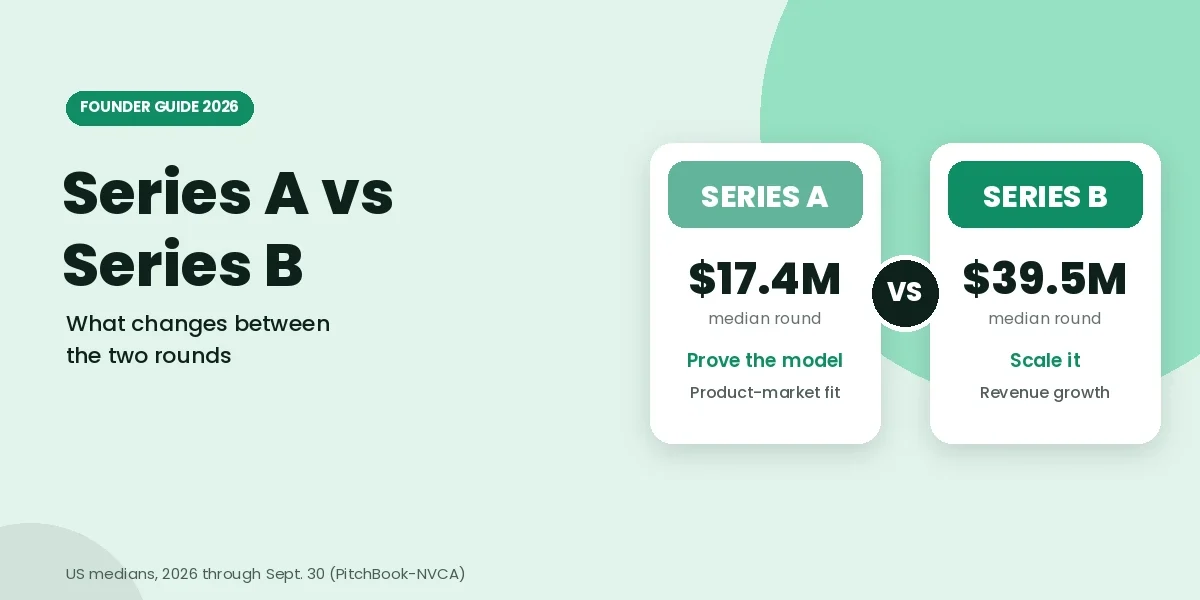
The short answer to Series A vs Series B: Series A is usually a startup’s first priced venture round, raised to prove the business model can grow. Series B comes once that model works, and it pays to scale it.
A median Series B in 2026 is roughly 1.6 to 2.3 times the size of a median Series A, depending on whose data you use, and far fewer companies get there than most founders expect.
Key takeaways
Series A vs Series B at a glance
The letters refer to the class of preferred stock sold in each priced round. Series A investors buy Series A preferred shares, the next priced round issues Series B preferred, and so on.
The labels carry no dollar threshold. They track the order of priced rounds, which is why a hot AI startup’s Series A can outsize a slower company’s Series B.
| What differs | Series A | Series B |
|---|---|---|
| Investor’s main question | Can this business model grow? | Does more money make it grow predictably? |
| What you usually show | A product in use, early revenue, a credible plan to find customers | Repeatable sales, retention, unit economics, a plan for the new money |
| Where the money goes | Finishing the product, first sales and marketing hires | Larger sales teams, new markets or segments, infrastructure |
| Typical lead investor | Early-stage venture firm | Larger multistage or growth-focused firm, with A investors often following on |
What Series A investors are buying
Carta describes Series A as the first priced round most companies raise: investors agree on a valuation, and that sets a share price for the company’s preferred stock. Money raised earlier through SAFEs or convertible notes usually converts into shares at this point.
At this stage, investors are pricing a future. You’ll usually have a product, early customers and some revenue but little history, so the team, the market size and early customer behavior carry most of the weight.
What changes at Series B
By Series B, the question is no longer whether customers want the product. It’s whether each extra dollar spent on sales, marketing and hiring produces growth you can predict.
That moves the pitch from story to spreadsheet. Expect investors to dig into customer acquisition cost against lifetime value, retention of existing revenue, gross margin, and how much cash you burn for each new dollar of revenue.
A quick self-check before you call your next raise a Series B:
- Can you show what the Series A money bought, in customers and revenue?
- Do new customers come from a channel you can repeat, not founder hustle alone?
- Does revenue from existing customers hold or grow year over year?
- Can you say what the new money buys, in headcount and expected revenue?
If two or more answers are shaky, you’re likely raising a bigger A or an extension, whatever the term sheet says. Our B2B SaaS companies list, filterable by funding stage, is a quick way to see where peers sit.
How big are Series A and Series B rounds in 2026?
Two major datasets track this, and they don’t agree. Here are both, with the B-to-A ratios worked out.
| Median (source, period) | Series A | Series B | B vs A |
|---|---|---|---|
| Round size (Carta, Q2 2026) | $14.7M | $23.3M | 1.6x |
| Post-money valuation (Carta, Q2 2026) | $76.3M | $166.2M | 2.2x |
| Deal size (PitchBook-NVCA, 2026 through Sept. 30) | $17.4M | $39.5M | 2.3x |
| Pre-money valuation (PitchBook-NVCA, 2026 through Sept. 30) | $60.3M | $187.0M | 3.1x |
| Deal size (PitchBook-NVCA, full-year 2025) | $13.7M | $30.0M | 2.2x |
Sources: Carta round benchmarks, Q2 2026 (US); PitchBook-NVCA Venture Monitor, Q3 2026 (US). The “B vs A” ratios are our calculations from the reported medians.
AI startups sit above both sets of medians. PitchBook put the 2026 median AI Series B at $46.0M on a $266.3M pre-money valuation.
Why Carta and PitchBook disagree
They measure different pools over different windows. Carta uses rounds recorded on its cap-table software in one quarter and reports post-money valuations.
PitchBook covers US deals it tracks over nine months, includes rounds mixing debt and equity, and infers a series from company age and funding history when the share class isn’t disclosed. Its valuations are pre-money.
Put on the same basis, the gap narrows but doesn’t close. Carta’s Series B median works out to about $142.9M pre-money ($166.2M minus the $23.3M raised, our calculation), against PitchBook’s $187.0M.
Our read: PitchBook’s sample probably tilts toward larger, announced rounds, while Carta’s reflects the broad base on its platform. Plan around Carta as the typical case and PitchBook as the upper middle.
What the dilution means for founders
A Series B is bigger in dollars but usually a smaller slice of the company, because valuations rise faster than round sizes. Carta’s Q2 2026 median dilution was 18.7% at Series A and 13.4% at Series B.
Dilution compounds, though. A founder holding 40% before a median Series A keeps about 32.5% after it (40% × 0.813), then about 28.2% after a median Series B (32.5% × 0.866).
Founder stake through two median rounds
Hypothetical 40% stake run through Carta’s Q2 2026 median dilution. Our calculation; option pool top-ups not included.
That leaves roughly 70% of the original stake, before the option pool increases investors often ask for at each round.
Is it hard to get Series B funding?
Yes, and timing you can’t control matters most. Carta tracked 10,562 US startups that raised a Series A from 2018 to 2025 (published February 2026):
- 2020 cohort: 20% reached Series B within a year and 40% within two.
- 2022 cohort: 8% within a year and 10% to 12% within two.
- 2024 cohort: 11% within a year, tracking toward roughly 20% by year two on Carta’s estimate.
Carta’s Peter Walker wrote that in a strong cohort about half of Series A companies eventually raise a B, and most of the rest shut down. The full Carta breakdown shows the cohort curves.
It also takes longer than the old 18 to 24 month rule. Carta’s July 2025 data put the median A-to-B gap at 2.7 years for US software startups (2.2 years for AI companies).
Gaps have started to shrink since: Carta’s Q1 2026 report says “the median gap is 2.1 years between Series A and Series B” (State of Private Markets Q1 2026, May 29, 2026). My take: budget a Series A to last at least two and a half years anyway, and treat a faster B as a bonus.
Is Series B risky?
Less than Series A on product risk, but not by much. In March 2026, Carta reported that two-year graduation rates to the next round sit close together at seed, Series A and Series B, and Walker concluded that a startup reaching B is still very likely to fail.
Price is the other risk. Series B investors pay a much higher valuation, so the company needs a bigger outcome for the round to pay off. Airtable sold to Bending Spoons for $1.285 billion in enterprise value (Bending Spoons, Aug. 2026; closed Sept. 4, 2026), against an $11.7 billion private valuation in 2021 (Bloomberg, Dec. 2021).
Is there a Series C funding?
Yes. Series C and later rounds pay for expansion, acquisitions or a run toward an IPO. PitchBook’s 2026 median Series C deal was $77.0M on a $500.0M pre-money valuation, through September 30.
Series A vs Class A shares: not the same thing
Is Class A or Class B stock better? Neither by default. Class A and Class B usually describe common stock with different voting power; at Alphabet, each Class B share carries 10 votes and each Class A share carries one.
Series A and Series B shares are preferred stock sold in funding rounds, typically with a liquidation preference that repays those investors before common holders in a sale. “Better” depends on whether you want votes, payout priority or the ability to sell.
If you searched for Series A vs Series B flanges, that’s ASME B16.47, a standard for large-diameter pipe flanges with no connection to startup funding.
Other questions founders ask
What is a Series A extension?
An extension, sometimes labeled A-1 or A-2, adds money to an existing round, usually on similar terms, to give a company more runway before its Series B. Carta strips extensions and bridges out of its time-between-rounds data, and its analysts noted in 2025 that many companies were raising bridge capital.
Who usually leads a Series B?
Typically a larger firm than the Series A lead, often a multistage or growth fund, with existing investors joining to protect their stake. Capital is concentrating: established firms raised 88.2% of US venture fund dollars through Q3 2026, per PitchBook-NVCA. Many sit in the Bay Area, covered in our Silicon Valley startups guide.
The label on a round matters less than the evidence behind it. Raise a Series B when you can show what the last dollar bought; until then, a bigger A or an extension is usually the honest name for it.