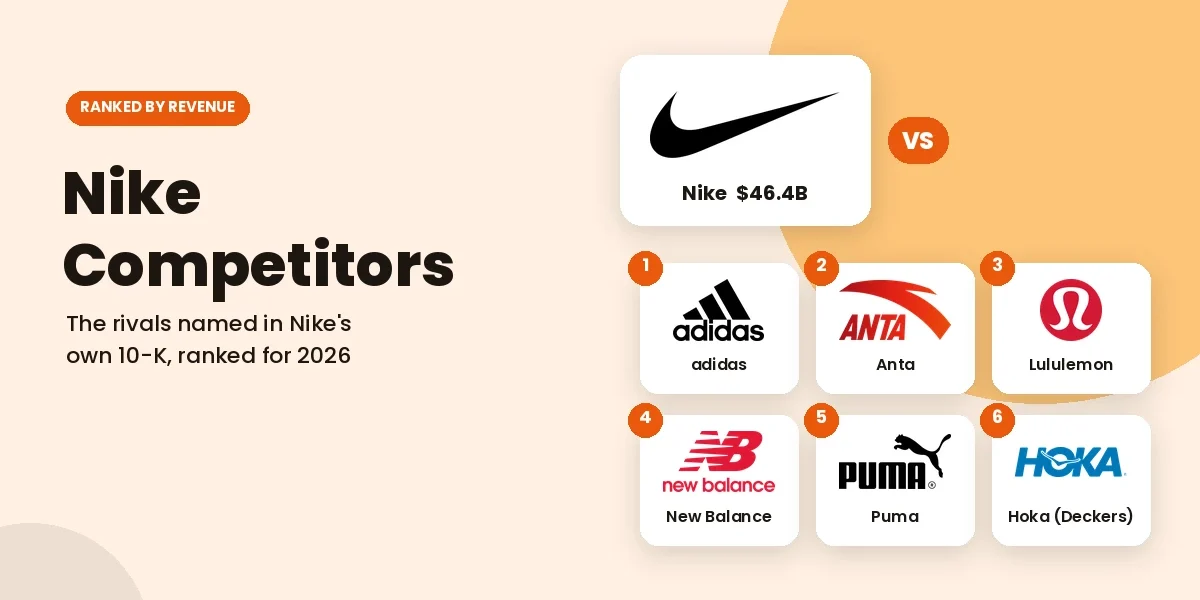
Nike’s biggest competitor is adidas, which reported record 2025 revenue of €24.8 billion, roughly $28 billion. Nike’s own fiscal 2026 annual report names 11 Nike competitors in total: adidas, Anta, ASICS, Deckers (owner of Hoka), Li Ning, Lululemon, New Balance, On, Puma, Under Armour and VF Corp.
Nike is still the largest of the group, with $46.4 billion in revenue for the year ended May 31, 2026. But that figure was flat, Nike now expects a high-single-digit decline this fiscal year, and several rivals grew by double digits over the same stretch.
Key takeaways
Who are Nike’s main competitors in 2026?
The most reliable answer comes from Nike itself. The “Competition” section of its fiscal 2026 Form 10-K lists adidas, Anta, ASICS, Deckers, Li Ning, Lululemon, New Balance, On, Puma, Under Armour and VF Corp as companies it competes with, “among others.”
Older filings show how that list grew, and when each name arrived.
Rivals named in Nike’s 10-K, by fiscal year
Source: “Competition” section of Nike’s 10-K filings for fiscal 2013, 2017 and 2019 through 2026, SEC EDGAR.
Look at who got added from 2019 on: a Chinese sportswear group, a privately held sneaker brand and two running-shoe specialists. That tells you where Nike sees new pressure coming from.
Nike competitors ranked by revenue
Revenue is the cleanest public yardstick. Fiscal calendars differ, so treat this as a close approximation, not an exact league table.
| Company | Listed | Latest full year | Reported revenue | Approx. USD | Change |
|---|---|---|---|---|---|
| Nike | NYSE: NKE | Year to May 31, 2026 | $46.4B | $46.4B | Flat |
| adidas | Xetra: ADS | 2025 | €24.81B | ~$28.0B | +13% (adidas brand, currency-neutral) |
| Anta Sports | HKEX: 2020 | 2025 | RMB 80.22B | ~$11.3B | +13.3% |
| Lululemon | Nasdaq: LULU | Year to Feb 1, 2026 | $11.1B | $11.1B | +5% |
| New Balance | Private | 2025 | $9.2B | $9.2B | +19% |
| Puma | Xetra: PUM | 2025 | €7.30B | ~$8.2B | -8.1% (currency-adjusted) |
| Deckers (Hoka, Ugg) | NYSE: DECK | Year to Mar 31, 2026 | $5.47B | $5.47B | +9.8% |
| ASICS | Tokyo: 7936 | 2025 | ¥810.9B | ~$5.4B | +19.5% |
| Under Armour | NYSE: UAA, UA | Year to Mar 31, 2026 | $5.0B | $5.0B | -4% |
| On | NYSE: ONON | 2025 | CHF 3.01B | ~$3.6B | +30% |
Sources: company results releases and filings from Nike (June 30, 2026), adidas (March 4, 2026), Anta (March 25, 2026), Lululemon (March 17, 2026), New Balance (Feb. 19, 2026), Puma (Feb. 26, 2026), Deckers (May 21, 2026), ASICS (Feb. 13, 2026), Under Armour (May 12, 2026) and On (March 3, 2026). The USD column for non-dollar reporters is my estimate using the IRS 2025 yearly average rates (0.886 euro, 7.129 yuan, 149.632 yen, 0.831 franc per dollar). New Balance is private and its figure isn’t audited.
Li Ning and VF Corp are on Nike’s list but not in the table. Li Ning sells mainly in mainland China, and VF’s biggest brands, Vans and The North Face, overlap with Nike only in parts of footwear and outerwear.
Who is Nike’s biggest competitor?
Ask who Nike’s rival is and most people say adidas. The numbers agree. adidas reported 2025 revenue of €24.81 billion, with the adidas brand up 13% on a currency-neutral basis for a second straight year, and operating profit of €2.06 billion (adidas, March 4, 2026).
The gap is closing fast. In 2023 adidas booked €21.43 billion against Nike’s $51.2 billion. At the IRS 2023 average rate of 0.924 euros per dollar, that made adidas about 45% of Nike’s size. Run the same math on adidas’s 2025 revenue and Nike’s fiscal 2026, and adidas is about 60% of Nike. That’s my calculation, and the periods don’t match exactly because Nike’s year ends in May.
The momentum hasn’t faded. adidas reported on October 29, 2026 that third-quarter revenue rose 9% to a record €7.25 billion, up 7% currency-neutral, with operating profit up 37% to €1.01 billion; it raised its 2026 operating profit outlook to about €2.5 billion and kept its 9% to 10% currency-neutral growth target (adidas, Oct. 29, 2026). Nike, by contrast, reported first-quarter fiscal 2027 revenue of $11.2 billion, down 4%, on October 1, 2026. If both companies hit their own guidance, the gap narrows again this year.
The fastest-growing Nike rivals
Most of the growth is coming from brands built around running shoes and sneaker culture, not from full-range sportswear giants.
On. The Swiss brand’s 2025 net sales rose 30% to CHF 3.01 billion, and Asia-Pacific sales nearly doubled to CHF 511.1 million (On 20-F, March 3, 2026). It guided for at least 23% constant-currency growth in 2026.
New Balance. The privately held company said 2025 sales grew 19% to $9.2 billion, its fifth straight year of double-digit growth, with North America up more than 20% and Europe up more than 30% (New Balance, Feb. 19, 2026, first reported by CNBC). It doesn’t publish profit figures.
ASICS. Net sales rose 19.5% to ¥810.9 billion in 2025, with operating profit up 42.4% to ¥142.5 billion (ASICS, Feb. 13, 2026). The company is forecasting ¥950 billion for 2026.
Hoka. Deckers’ running brand grew 15.9% to $2.59 billion in the year to March 31, 2026, and Deckers expects low-double-digit Hoka growth this fiscal year (Deckers, May 21, 2026).
Combined, these four did about $20.8 billion in sales in their latest years, by my conversion. Hoka and On are still small next to Nike. Their growth rates are the worry, and both now appear by name in its 10-K.
Anta: the rival many US shoppers miss
Anta Sports barely registers in US malls, yet by my conversion it’s the third-largest company in the table. Revenue rose 13.3% to RMB 80.22 billion in 2025 across brands including Anta, FILA (in China), Descente, Kolon Sport and Jack Wolfskin (Anta annual results, March 25, 2026). Anta says its share of China’s sportswear market reached 21.8%, citing third-party data.
It’s also the largest shareholder of Amer Sports, which owns Arc’teryx, Salomon and Wilson. In January 2026, Anta agreed to buy a 29.06% stake in Puma from the Pinault family’s holding company Artémis for about €1.5 billion and ruled out a full takeover (Reuters, Jan. 27, 2026). Anta completed the purchase on Oct. 7, 2026, making it Puma’s biggest shareholder (Anta, Oct. 7, 2026).
So Anta competes with Nike as a portfolio, not a single brand. In China, it’s arguably Nike’s most direct threat.
Rivals with problems of their own
Puma called 2025 a “reset” year. Sales fell 8.1% currency-adjusted to €7.30 billion, it posted a loss and proposed no dividend, and it has labeled 2026 a transition year (Puma, Feb. 26, 2026). Reuters noted Puma had lost ground to Nike and adidas while facing faster-growing brands like New Balance and Hoka.
Under Armour revenue fell 4% to $5.0 billion in fiscal 2026, with North America down 8%, and it expects a slight decline again this year (Under Armour, May 12, 2026).
Lululemon is a mixed picture. Revenue rose 5% to $11.1 billion, but Americas revenue fell 1% while international revenue grew 22% (Lululemon, March 17, 2026). It competes with Nike mostly in apparel rather than shoes.
What brands are comparable to Nike?
It depends on which part of Nike you’re comparing:
- Full range of shoes, apparel and team sports: adidas, Puma, Under Armour, Anta
- Running shoes: Hoka, On, ASICS, New Balance
- Training and athleisure apparel: Lululemon
- Lifestyle sneakers: New Balance and VF’s Vans
Nike also competes with itself here. Its Converse brand saw revenue drop 31% to $1.2 billion in fiscal 2026 (Nike, June 30, 2026).
Is Nike losing ground to its competitors?
My take: yes, but not evenly. Nike still outsells adidas by roughly $18 billion, and North America grew in its latest quarter. The weakness sits in specific places. In the quarter to August 31, 2026, Nike Direct revenue fell 8%, driven by a 13% drop in Nike Brand Digital, while Greater China and EMEA declined (Nike, Oct. 1, 2026).
The digital slide is the one to watch; for context on how much buying now happens on phones, see our mobile ecommerce statistics. Nike’s fix, which it calls the Sport Offense, puts performance product back at the center. It’s worth reading alongside Nike’s vision statement.
The squeeze comes from two directions at once. adidas is closing in at scale, while Hoka, On, New Balance and ASICS pick off premium running and lifestyle buyers. Nike can survive either one. Handling both while it cuts costs is the harder test.
FAQ
What is Nike’s market share compared with its competitors?
There’s no free, audited global market-share figure; estimates come from paid research firms. Revenue is the best public proxy. By my conversion, Nike’s $46.4 billion in fiscal 2026 roughly matches adidas, Anta and Puma combined, about $47.5 billion at IRS 2025 average exchange rates.
Which Nike competitors are publicly traded?
adidas and Puma trade in Germany, Anta and Li Ning in Hong Kong, and ASICS in Tokyo. Lululemon, Deckers, Under Armour, On and VF Corp trade in New York. New Balance is privately owned, and Skechers went private in 2025, so neither publishes full public financials.
Is Skechers a Nike competitor?
Yes in lifestyle and walking shoes, though Nike’s 10-K doesn’t name it. Investment firm 3G Capital completed its acquisition of Skechers on September 12, 2025, and the shares were delisted from the NYSE. That means Skechers no longer reports quarterly results publicly, which is why it isn’t in the table above.