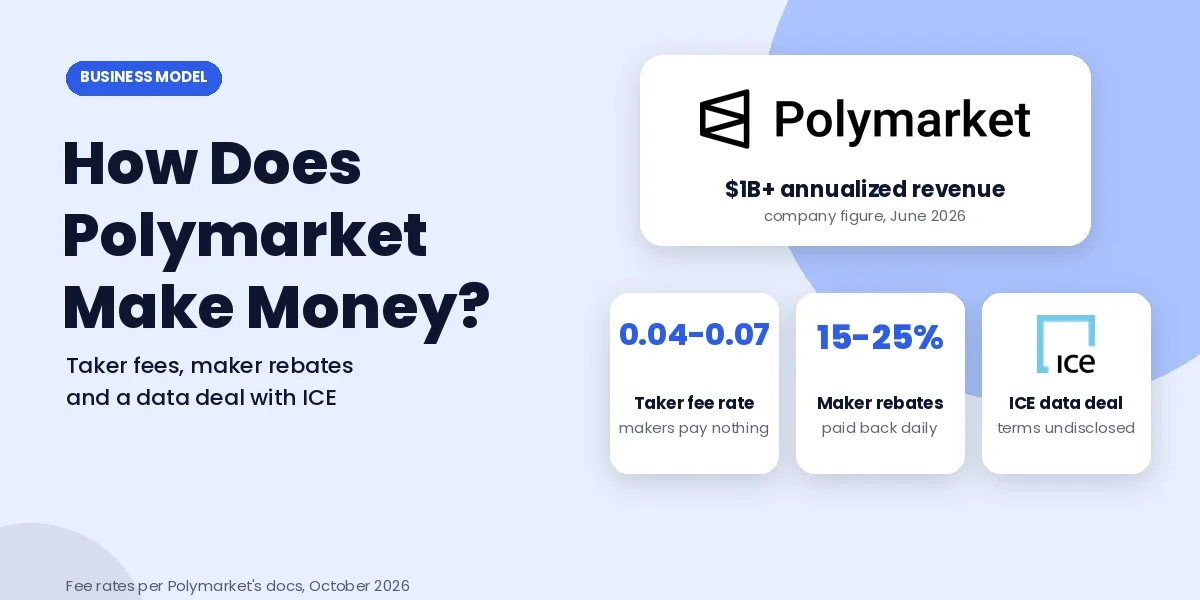
Polymarket makes money mainly from trading fees: it charges takers, the traders whose orders fill instantly, a small fee on most markets, while makers pay nothing and get part of that fee back. It also earns fees on its CFTC-regulated US exchange and has a data-distribution deal with NYSE owner ICE.
That’s a recent change. For most of its life, Polymarket charged nothing to trade.
In June 2026, the company told CNBC its annualized revenue had passed $1 billion (CNBC; Reuters, June 26, 2026). It hasn’t published profit figures.
Key takeaways
How does Polymarket make money on each trade?
Every Polymarket market is a set of shares that pay $1 if an outcome happens and $0 if it doesn’t. Traders buy and sell those shares from each other on an order book, so the price, say 62 cents, reads as the market’s odds.
Polymarket doesn’t take the other side of your trade. It earns when trades match: under its published fee schedule, takers pay a fee calculated as shares × fee rate × price × (1 − price). Makers, who post orders that wait on the book, pay nothing.
Rates depend on the category. Crypto markets use 0.07, sports, economics, culture and weather use 0.05, and politics, finance, tech and mentions use 0.04. Geopolitics and world events markets carry no fee.
The fees started small: The Block reported on Jan. 6, 2026 that Polymarket had added taker fees to its 15-minute crypto markets while leaving most others free. Polymarket’s own fee documentation now lists fees in nearly every category.
What a $100 trade actually costs
Because of the price × (1 − price) term, the fee per share peaks at 50 cents. But as a share of the money you put in, the fee works out to the rate × (1 − price), so it’s steepest on long shots.
| Taker fee on a $100 buy | At 10¢ | At 50¢ | At 90¢ |
|---|---|---|---|
| Crypto (0.07) | $6.30 | $3.50 | $0.70 |
| Sports, economics, culture, weather (0.05) | $4.50 | $2.50 | $0.50 |
| Politics, finance, tech (0.04) | $3.60 | $2.00 | $0.40 |
| Polymarket US, standard contracts (0.0695) | $6.26 | $3.48 | $0.70 |
| Geopolitics (0) | $0 | $0 | $0 |
Our calculation from Polymarket’s fee documentation (October 2026) and Polymarket US’s Sept. 29, 2026 CFTC fee filing. Ignores rounding and taker rebates; maker orders pay nothing.
So a trader buying 10-cent long shots in sports pays 4.5% of their stake to Polymarket, while someone buying 90-cent favorites pays 0.5%. Per share, though, the biggest dollar fees come from trades near 50/50.
Where the fee money goes
Polymarket doesn’t keep every dollar. Its Maker Rebates Program pays market makers a share of the fees from each market daily: 20% in crypto, 15% in sports and 25% in most other categories. A separate tiered program lets high-volume takers earn some fees back.
Where $2.50 of fees goes on a $100 sports buy at 50¢
Our calculation using Polymarket’s published sports fee rate and maker rebate share.
In other words, on most markets Polymarket keeps roughly 75% to 85% of gross taker fees before taker rebates, depending on the category. The rebates are a cost of doing business: makers supply the liquidity that keeps spreads tight and takers coming back.
Polymarket’s revenue streams: what’s disclosed and what isn’t
| Stream | How it works | What’s public |
|---|---|---|
| Taker fees, international platform | Charged when taker orders fill | Rates published; revenue not broken out |
| Taker fees, Polymarket US | Same formula on the CFTC-regulated exchange | Rates filed with the CFTC; revenue not broken out |
| Data distribution via ICE | ICE sells Polymarket sentiment data to institutions | Announced Oct. 2025; financial terms undisclosed |
| Perpetual futures | Tiered maker and taker fees, 0.04% for new takers | Fee schedule in docs; no volume or revenue figures |
The ICE deal came with ICE’s investment of up to $2 billion in cash at a pre-money valuation of about $8 billion, announced in October 2025. Beyond data, the two said they’d work together on tokenization.
Two things are often attached to Polymarket’s business model without evidence. It doesn’t charge deposit or withdrawal fees, per its docs, though third-party on-ramps may. And it hasn’t said whether it earns interest on the stablecoins users hold on the platform, so treat that as unknown.
How much revenue does Polymarket make, and is it profitable?
The only figure from the company is the one it gave CNBC on June 26, 2026: annualized revenue above $1 billion, six weeks after its US exchange opened to the public. An annualized figure takes a recent stretch of revenue and projects it over a year, so it’s a run rate, not booked annual revenue.
Profitability isn’t disclosed. Polymarket is private and doesn’t publish expenses, and its costs include maker and taker rebates, a US exchange build-out and lawsuits with state regulators.
Investors are paying for growth either way. Bloomberg reported on Aug. 31, 2026 that Polymarket raised $1 billion in a round led by 1789 Capital at a $21 billion post-money valuation.
Set against the June run rate, that’s about 21 times revenue (our calculation, mixing figures from different months). For how that round compares with the year’s AI mega-raises, see our list of 2026’s biggest AI funding rounds.
Our read: fee revenue at that scale probably covers day-to-day costs, but nobody outside the company can confirm it. Treat any “Polymarket profit” figure you see online as an estimate unless it comes from Polymarket or a filing.
Do you actually get money from Polymarket?
Yes, if your side wins. Each winning share redeems for $1 when the market resolves, and that payout comes from the traders on the losing side, not from Polymarket’s own funds.
Polymarket’s cut is the taker fee, paid when you trade rather than when you win. If you only post maker orders, you pay no trading fee and may earn a small rebate.
Is Polymarket illegal in the US?
It’s federally regulated now, but its legal status is contested in some states. On January 3, 2022, the CFTC fined Polymarket’s operator, Blockratize, $1.4 million for offering unregistered event-based binary options and ordered it to wind down noncompliant markets (CFTC). Polymarket then blocked US users from its main platform.
It came back through QCX LLC, doing business as Polymarket US, a CFTC-registered exchange that launched in December 2025, according to New York’s attorney general. Its fees are filed with the CFTC like any other regulated futures exchange.
States are pushing back. On Sept. 24, 2026, New York sued Polymarket US, alleging it runs an unlicensed gambling operation and lets 18- to 20-year-olds bet.
The state seeks fines of three times Polymarket’s gains, and Polymarket filed a countersuit, CNBC reported. New York filed a similar suit against Kalshi in July 2026.
Whether you can legally use it depends on where you live and how those cases end. This isn’t legal advice.
For a similar look at a business built on many small transactions, see how Royal Kingdom makes money. Polymarket’s version comes down to a fee formula a few lines long, a data deal with ICE, and a regulatory fight that will decide how big its US business can get.