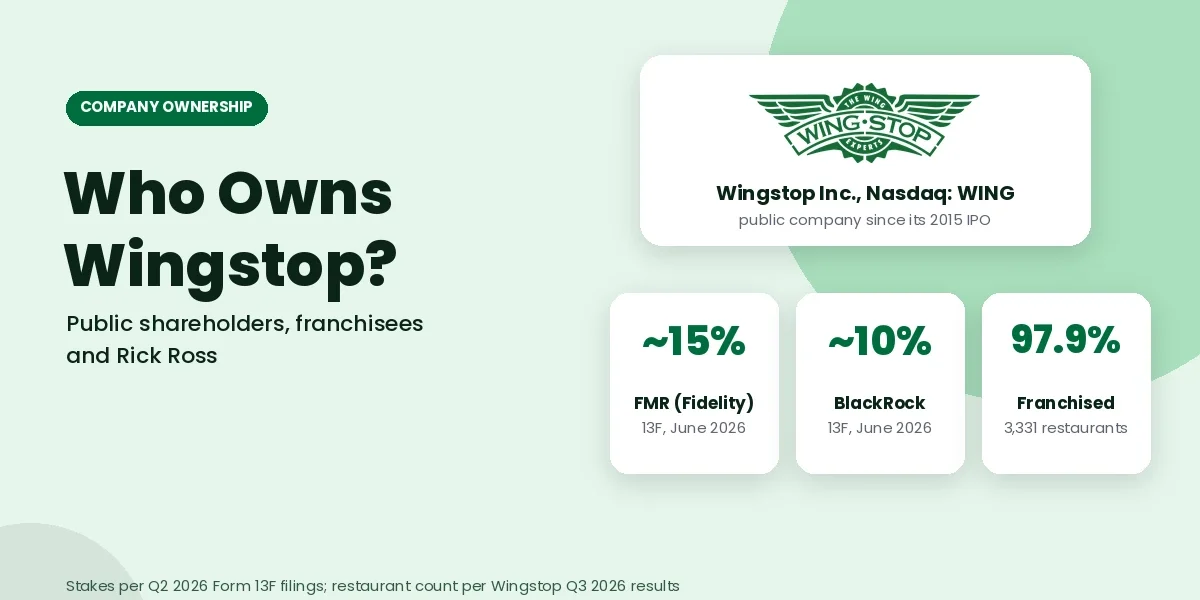
Wingstop is owned by its public shareholders. Wingstop Inc. has traded on the Nasdaq under the ticker WING since its 2015 IPO, and its largest holders are fund managers: Fidelity’s parent FMR with about 15% and BlackRock with about 10% at the end of June 2026, based on their Form 13F filings with the SEC.
The restaurants are a different story. About 98% of Wingstop locations are owned and run by franchisees, and that’s where Rick Ross comes in. He’s one of them, not the owner of the company.
Who are the owners of Wingstop?
A public company has thousands of owners. Large fund managers report their holdings to the SEC each quarter on Form 13F. These were the largest holders on June 30, 2026, the latest quarter on file.
| Holder | Shares | Stake | As of |
|---|---|---|---|
| FMR LLC (Fidelity) | 4,092,059 | 15.0% | Jun 30, 2026 (13F) |
| BlackRock, Inc. | 2,775,585 | 10.2% | Jun 30, 2026 (13F) |
| Darsana Capital Partners | 1,500,000 | 5.5% | Jun 30, 2026 (13F) |
| Massachusetts Financial Services | 1,307,004 | 4.8% | Jun 30, 2026 (13F) |
| T. Rowe Price Investment Management | 1,238,363 | 4.5% | Jun 30, 2026 (13F) |
| Vanguard Capital Management | 1,230,190 | 4.5% | Jun 30, 2026 (13F) |
Sources: each firm’s Form 13F for the quarter ended June 30, 2026, filed with the SEC in August 2026. Stakes are our calculation using the 27,240,351 shares Wingstop reported outstanding on June 27, 2026. Third-quarter 13Fs are due by November 14, 2026.
Most of these firms hold shares for index funds, mutual funds and pension clients; Darsana is a hedge fund. They vote at annual meetings but don’t run the business, and none comes close to control.
Day-to-day decisions sit with management and an 11-member board chaired by Lynn Crump-Caine, which added PENN Entertainment CEO Jay Snowden in August 2026. Ten of the 11 directors are independent; the other is Michael Skipworth, president and CEO since March 2022.
Who owns the Wingstop restaurants?
Mostly franchisees, which Wingstop calls brand partners. As of September 26, 2026, Wingstop reported 3,331 restaurants: 2,716 franchised in the US, 544 franchised internationally (including US territories) and 71 company-owned. That’s 97.9% franchised.
The company-owned count recently rose. Wingstop bought 13 franchised restaurants in the third quarter of 2026, which, with one new opening, took its own stores from 57 to 71.
Who owns what at Wingstop, and where Q3 2026 money went
Of every $100 spent at a Wingstop in Q3 2026, about $12.90 reached Wingstop Inc. as revenue (our calculation from the company’s Q3 2026 results).
That ratio is the heart of the model. Wingstop doesn’t need to own restaurants to earn from them; it collects royalties and fees on franchisee sales, while franchisees carry most of the cost of building and running stores.
Does Rick Ross still own Wingstop?
Rick Ross has never owned Wingstop the company. He’s a franchisee, operating through a family business called Boss Wings Enterprises LLC, which lists Ross, his sister Tawanda Roberts and his mother Tommie Roberts as owners. In 2018, then-CEO Charlie Morrison said some fans assume Ross owns the whole chain, which is where the confusion starts.
The clearest public record of his Wingstop business is a 2022 Labor Department case. Investigators found illegal pay deductions at five Mississippi Boss Wings locations and recovered $114,427 in back wages, damages and penalties, Fox Business reported in August 2022.
How many Wingstops does Rick Ross own?
There’s no current official count. Reports have ranged from at least nine locations in 2016 to nearly 30 in later coverage, and neither Ross nor Wingstop has published a verified number. Stores also change hands; a Boss Wings location in Starkville, Mississippi, was sold to another franchisee in 2022, the Commercial Dispatch reported.
Here’s the scale check. Even at 30 restaurants, Ross’s group would run about 0.9% of Wingstop’s 3,260 franchised locations. He’s a well-known franchisee with real money in the system, but he isn’t among the disclosed 5% shareholders, and any shares he holds in Wingstop Inc. are undisclosed.
How Wingstop got here
Antonio Swad opened the first Wingstop in Garland, Texas, in 1994, and the chain began franchising in 1997. It passed through private equity hands before Roark Capital Group bought it in 2010, Nation’s Restaurant News reported, and Roark took Wingstop public in June 2015.
Roark then sold down. By February 2018, Wingstop’s board was amending its bylaws to strip out references to Roark Capital, a change the company’s 2026 proxy statement put to a vote and shareholders ratified in May 2026. Since then, no single investor has controlled the company.
Is Wingstop owned by Pizza Hut?
No. Wingstop is an independent public company with no corporate parent. The mix-up likely comes from WingStreet, the wing brand Pizza Hut runs inside its own restaurants under Yum! Brands. The two compete.
What owning Wingstop stock actually gets you
My take: if you buy WING shares, you own a sliver of a franchisor, a company whose main assets are a brand and a growing network of royalty-paying partners. You don’t own any restaurant, and 2026 has been a tougher sales year, with domestic same-store sales down 5.4% in the third quarter.
The company still states its vision as becoming a top 10 global restaurant brand, a framing you can compare with Nike’s vision statement. And Wingstop remains one of the Dallas area’s homegrown public companies; for the city’s earlier-stage side, see our guide to Dallas startups.
FAQ
Can I buy Wingstop stock?
Yes. Wingstop trades on the Nasdaq as WING, so anyone with a brokerage account can buy shares. Owning stock makes you a part-owner of Wingstop Inc., the franchisor, but not of any individual restaurant. Restaurant ownership comes through a franchise agreement, which Wingstop awards separately to approved operators.
Where is Wingstop headquartered?
Dallas, Texas. Wingstop’s executive offices are at 2801 N Central Expressway, according to its 2026 proxy statement. The chain was founded in nearby Garland in 1994 and has stayed in the Dallas area through its private equity years and its time as a public company.