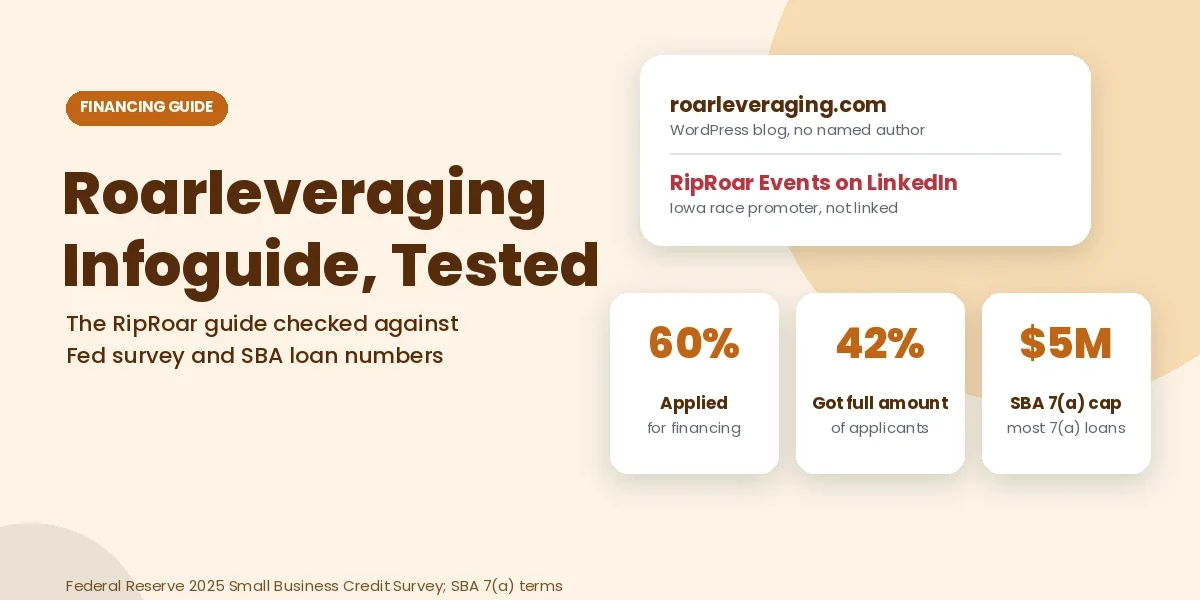
Sixty percent of US small employer firms applied for financing in the year before the Federal Reserve’s 2025 Small Business Credit Survey. Only 42% of those applicants received the full amount they sought.
The roarleveraging business infoguide by riproar promises to help owners grow by using their resources well. The pages that describe it offer no numbers. This piece supplies them, using SBA loan rules and Fed survey data, so the idea of borrowing to grow can be tested with real costs.
What the roarleveraging business infoguide by riproar claims to be
Roarleveraging.com is a WordPress blog. Its homepage essay describes roarleveraging as a mindset of using ideas, passion and resources to grow a business. It names no author, company or credentials.
The same site publishes off-topic posts, including a July 16, 2026 article on massage types and a May 31, 2026 guide to registering on the Bybit crypto exchange. Its menu lists finance, loan, tax and financial planning categories.
Other pages ranking for the term are explainers that repeat the same themes. One calls it a conceptual framework used in SEO content. A RipRoar Events profile on LinkedIn belongs to an Iowa race promoter and has no link to the guide.
In short, the brand has no product or method behind it. The useful question it raises is a real one: when does borrowing money help a small business grow, and what does it cost?
Small business financing data behind any roarleveraging plan
The 2026 Report on Employer Firms, released March 3, 2026, draws on 6,525 responses from firms with 1 to 499 employees. The survey ran from September 3 to November 14, 2025.
Applicants did not all get what they asked for. The split among firms that applied for any financing was as follows.
Where firms applied changed the result. Applicants at small banks were the most likely to be fully approved, at 57%. The share of applicants turning to online fintech lenders rose from 17% in the 2020 survey to 29% in 2025.
Online loans often cost more than borrowers planned. Sixty percent of online lender borrowers said actual costs ran higher than expected.
SBA loan terms that set the cost of business debt
SBA-backed loans are the main federal route to small business credit. The SBA does not lend directly in its 7(a) program. It guarantees part of a loan made by a bank or other lender.
SBA 7(a) loan limits and maturities
According to the SBA’s 7(a) terms page, most 7(a) loans top out at $5 million, and SBA Express loans at $500,000. The SBA guarantees up to 85% of loans of $150,000 or less and up to 75% of larger loans.
Terms run 10 years or less unless the loan finances real estate or long-life equipment. Real estate loans can run up to 25 years.
Loans of 15 years or longer carry a prepayment fee in the first three years if the borrower repays 25% or more early. The fee is 5% in year one, 3% in year two and 1% in year three.
SBA 7(a) interest rate caps at today’s prime rate
Lenders set the rate, but the SBA caps variable rates at a base rate plus a spread tied to loan size. With the Wall Street Journal prime rate at 7.00% as of October 27, 2026, per Federal Reserve data on FRED, the caps work out as shown.
Smaller loans carry higher caps because the spread is wider. A $40,000 loan can legally cost 3.5 points more than a $400,000 loan.
SBA microloans for smaller amounts
The SBA microloan program lends up to $50,000 through nonprofit intermediaries. The SBA puts the average microloan at about $13,000, with rates generally between 8% and 13% and a maximum term of seven years.
Debt versus equity: roarleveraging examples with real numbers
Borrowing adds a fixed monthly cost. Selling equity adds no payment but gives away a share of future value. The table below prices four SBA 7(a) loans at the maximum variable rates above, assuming fixed monthly payments.
| Loan amount | Rate cap used | Term | Monthly payment | Total interest |
|---|---|---|---|---|
| $50,000 | 13.5% | 7 years | $923 | $27,553 |
| $200,000 | 13.0% | 7 years | $3,638 | $105,625 |
| $200,000 | 13.0% | 10 years | $2,986 | $158,346 |
| $1,000,000 | 10.0% | 25 years | $9,087 | $1,726,102 |
Stretching the $200,000 loan from 7 to 10 years cuts the payment by $652 a month. It also adds $52,721 in interest.
Illustration: an owner needs $200,000. Option A is the 10-year loan above, costing $358,346 in total repayments.
Option B is selling a 20% stake for $200,000. If the business later sells for $3 million, that stake is worth $600,000. If it sells for $1 million, the stake is worth $200,000.
Debt costs less when the business grows fast. Equity costs less when growth stalls, because the investor shares the loss.
Debt also carries personal risk. The Fed survey found that 59% of firms with debt had signed a personal guarantee, which puts the owner’s own assets behind the loan.
Where roarleveraging advice falls short
The roarleveraging pages tell owners to audit assets, cut costs and grow. They skip the tests a lender will apply. Before borrowing, check each of these.
- Monthly cash flow covers the new payment with room to spare, after owner pay.
- The money funds something that earns more than its interest rate, such as equipment that adds billable capacity.
- You have priced the loan at a small bank and an SBA lender before accepting an online offer.
- You know whether the rate is fixed or variable, and what a one-point prime rate rise would add.
- You have read the prepayment terms if the maturity is 15 years or longer.
The SBA’s Lender Match tool and local SBA district offices can connect owners with participating lenders at no charge.
FAQ
What is the roarleveraging business infoguide by riproar?
It is a brand phrase used by roarleveraging.com and many copycat explainers. It describes growing a business by using resources well, but offers no named author, product or data.
Is RipRoar a real company behind the guide?
No company is identified. A RipRoar Events page on LinkedIn belongs to an Iowa race promoter with no stated link to roarleveraging.com or its content.
What is the maximum SBA 7(a) loan amount?
Most 7(a) loans have a $5 million maximum. SBA Express and Export Express loans cap at $500,000, according to the SBA.
What is the highest rate on an SBA 7(a) loan now?
At a 7.00% prime rate, variable caps run from 13.5% on loans of $50,000 or less to 10.0% on loans above $350,000. Lenders can charge less.
How many small businesses get the full loan they ask for?
In the Fed’s 2025 survey, 42% of financing applicants got the full amount, 36% got some or most, and 22% got none.