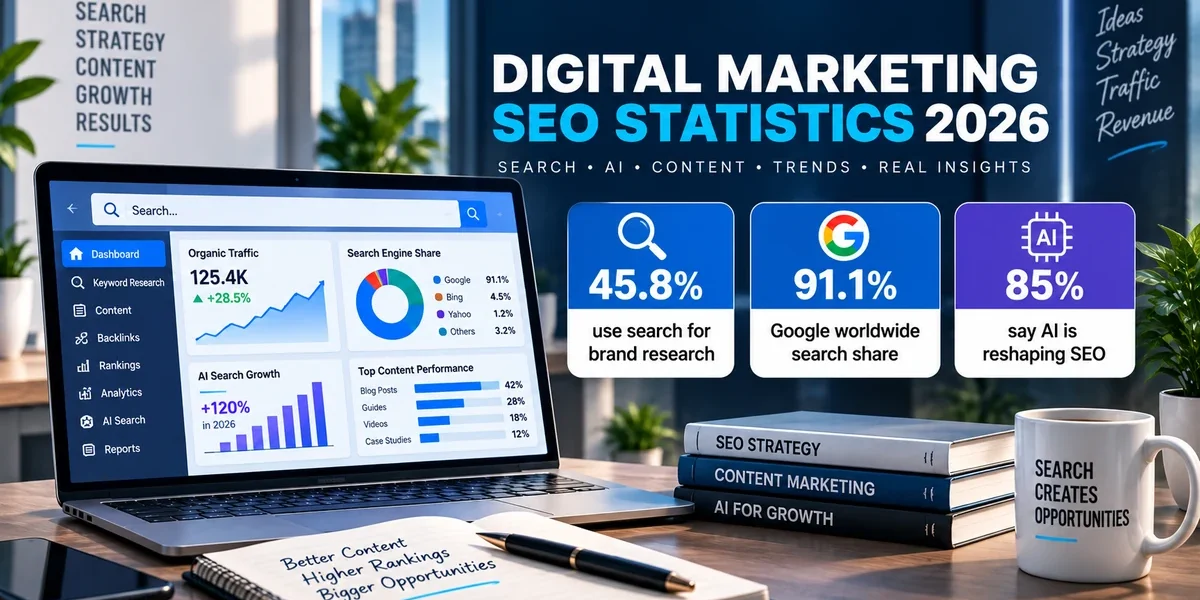
Digital marketing SEO statistics show that search still plays a large role in discovery: 45.8% of online adults use search engines to research brands, products, and services, according to DataReportal’s 2026 mid-year report. Google also held 91.10% of worldwide search engine share in August 2026, according to StatCounter.
In This Article
- Key Statistics at a Glance
- Search Market Share and Search Behavior
- Search in Digital Marketing and Buyer Discovery
- AI Search and Answer Engine Optimization
- Organic Clicks, CTR, and Zero-Click Search
- Content Marketing and SEO Production Benchmarks (2025)
- SEO Content Formats, Distribution, and Results
- Marketing AI Adoption and SEO Operations
- Technical SEO, Measurement, and Conversion Signals
- How to Use These Statistics
The clearest signal in 2026: Search remains widely used for brand research at 45.8%, while AI services are used by 22.1% for the same task.
Key Statistics at a Glance
- 45.8% of online adults use search engines to research brands, products, and services (DataReportal, 2026)
- Google held 91.10% of worldwide search engine share in August 2026 according to data from Statista
- AI Mode surpassed 1 billion monthly active users globally by May 2026 as reported by TechCrunch
- 85% of marketers said AI was reshaping their SEO strategy (Salesforce, 2026)
- 58.5% of U.S. Google searches in a 2024 clickstream study ended without a click (SparkToro and Datos, 2024)
Search Market Share and Search Behavior
Worldwide Search Engine Market Share (August 2026)
| Search Engine | Worldwide Share | Desktop Share | Mobile Share |
| 91.10% | 86.05% | 95.59% | |
| Bing | 4.50% | 8.84% | 0.60% |
| Yahoo | 1.23% | 2.15% | 0.47% |
| Yandex | 0.99% | 1.10% | 0.90% |
| DuckDuckGo | 0.70% | 0.70% | 0.69% |
| Baidu | 0.62% | 0.34% | 0.84% |
Key Insight: Google dominates across all device types, with particularly strong mobile market share at 95.59%. Desktop shows more competitive pressure from Bing (8.84%), while mobile is almost exclusively Google-focused.
Search Volume and Visual Search
- Google processed more than 5 trillion searches per year in 2025 (Google, 2025)
- Google Lens handled more than 20 billion visual searches per month in 2025 (Google, 2025)
- One in four Google Lens searches carried commercial intent (Google, 2025)
- 79% of Gen Z consumers in India reported using Google and/or YouTube daily in 2025 (Google, 2025)
- Google and/or YouTube appeared in 87% of India consumer journeys where people discovered a new brand, product, or retailer in 2025 (Google, 2025)
- 90% of social media users in India used Google Search to inform and evaluate products they discovered in 2025 (Google, 2025)
Search in Digital Marketing and Buyer Discovery
Brand Discovery Methods (2026)
| Discovery Method | Usage Rate |
| Search engines | 32.4% |
| TV ads | 31.2% |
| Social media ads | 30.1% |
| Outdoor posters/billboards | 16.7% |
| AI tools | 14.8% |
Brand Research Behavior (2026)
- 45.8% of online adults used search engines to research brands, products, and services (DataReportal, 2026)
- 22.1% of online adults used AI services to research brands, products, and services (DataReportal, 2026)
- Search engines were used for brand research at 2.07 times the rate of AI services (DataReportal, 2026)
- The share of people using search engines for brand research fell by more than 10% on a relative basis across the prior 18 months (DataReportal, 2026)
AI Search and Answer Engine Optimization
AI Overview Adoption
- AI Overviews reached more than 1.5 billion monthly users by 2025 (Google, 2025)
- AI Overviews were available in more than 200 countries and territories by May 2025 (Google, 2025)
- AI Overviews supported more than 40 languages by May 2025 (Google, 2025)
- Google said AI Overviews increased usage by more than 10% for query types where the feature appeared in large markets such as the U.S. and India in 2025 (Google, 2025)
AI Mode Growth and User Behavior
- AI Mode surpassed 1 billion monthly active users globally by May 2026 (Google, 2026)
- AI Mode query volume more than doubled every quarter from launch through May 2026 (Google, 2026)
- Early AI Mode testers asked queries two to three times as long as traditional searches in 2025 (Google, 2025)
- 75% of people surveyed by Google said AI Mode helped them make faster, more confident decisions in 2026 (Google, 2026)
Marketer Response to AI Search
- 85% of marketers said AI was reshaping their SEO strategy (Salesforce, 2026)
- 88% of marketers said they had started optimizing for AI-generated responses in 2026 (Salesforce, 2026)
- High-performing marketers were 2.2 times more likely than underperformers to have optimized for AI search in 2026 (Salesforce, 2026)
AI Overview Trigger Rates Over Time (Semrush Study)
| Time Period | AI Overview Appearance Rate |
| January 2025 | 6.49% |
| July 2025 | 24.61% |
| November 2025 | 15.69% |
- The AI Overview trigger rate rose 18.12 percentage points from January to July 2025
- The AI Overview trigger rate fell 8.92 percentage points from July to November 2025
Query Type Distribution Among AI Overviews
| Query Type | January 2025 | October 2025 | Change |
| Informational | 91.3% | 57.1% | -34.2 pp |
| Navigational | 0.74% | 10.33% | +9.59 pp |
Organic Clicks, CTR, and Zero-Click Search
Zero-Click Search Rates (2024 Study)
- 58.5% of U.S. Google searches ended without a click (SparkToro and Datos, 2024)
- 59.7% of EU Google searches ended without a click (SparkToro and Datos, 2024)
- The EU zero-click rate was 1.2 percentage points higher than the U.S. rate
- Roughly 37% of searches ended the session without another search action
- Roughly 22% of searches led the user to change the query rather than click a result
Click-Through Rate Benchmarks (Backlinko 2025)
- The number one organic Google result had a 27.6% average CTR
- The number one organic result was 10 times more likely to receive a click than the result in position 10
- Only 0.63% of Google searchers clicked a result on page two
- 90.3% of queries generated 10 impressions or fewer
- The study reported an average of 25.1 clicks per query across its dataset
Study Scope: Backlinko analyzed roughly 4 million Google search results covering 1,312,881 pages and 12,166,560 search queries.
Organic Click Volume and Quality (August 2025)
- Google said total organic click volume from Search to websites was relatively stable year over year (Google, 2025)
- Google said average click quality from Search increased year over year (Google, 2025)
Content Marketing and SEO Production Benchmarks (2025)
Content Team Structure
- 76% of B2B marketers had a dedicated content marketing team or person on staff (Content Marketing Institute, 2025)
- 54% of B2B marketers with dedicated content staff said the team had two to five people
- 24% of B2B respondents had no dedicated content marketing team or staff
Content Strategy Effectiveness
| Rating | Percentage |
| Extremely or very effective | 29% |
| Moderately effective | 58% |
| Not very effective | 12% |
| Not at all effective | 1% |
- 95% of B2B marketers said their organization had a content strategy
Reasons for Lower Strategy Effectiveness
- 42% cited a lack of clear goals
- 39% cited weak alignment with the customer journey
- 35% cited a strategy that was not data-driven
- 29% cited ineffective audience research
- 23% cited unrealistic expectations
- 20% cited too much emphasis on content quantity rather than quality
- 18% cited failure to iterate or adapt
- 17% cited inconsistent brand voice
- 10% cited poor content quality
Top Content Challenges (2025)
- 47% said measuring content results was a challenge
- 45% said aligning content with the buyer journey was a challenge (down from 48% prior year)
- 43% said aligning content across sales and marketing was a challenge (down from 45%)
- 43% said differentiating content was a challenge (down from 54%)
- 42% said creating content consistently was a challenge (down from 54%)
- 40% said creating the right content for the audience was a challenge (down from 57%)
- 35% said SEO optimization was a top content challenge (down from 45%)
- 33% cited workflow or content approval issues (down from 41%)
- 33% cited access to subject matter experts (down from 39%)
- 27% cited keeping up with new technologies (down from 34%)
- 27% said creating quality content was a challenge (down from 44%)
Content Measurement
- 96% said they measure content performance
- 51% agreed that their organization measures content performance effectively
- 56% cited difficulty attributing ROI to content efforts
- 56% cited difficulty tracking customer journeys
- 44% cited inability to tie content performance to business goals
- 41% cited insufficient resources or budget for measurement
- 39% cited a lack of clear marketing goals or KPIs for measurement
SEO Content Formats, Distribution, and Results
Reported Content Benefits
- 87% of B2B marketers said content marketing helped create brand awareness (prior 12 months)
- 74% said content marketing helped generate demand or leads
- 62% said it helped nurture subscribers, audiences, or leads
- 52% said it grew loyalty among existing customers
- 49% said it helped generate sales or revenue
- 37% said it helped grow a subscribed audience
- 9% said it reduced customer support costs
- 22% characterized their content marketing approach as extremely or very successful
Content Formats Used
| Format | Usage Rate | Effectiveness Rating |
| Short articles/posts | 92% | 43% |
| Video | 76% | 58% |
| Case studies/customer stories | 75% | 53% |
| Long articles/posts | 69% | — |
| Data visualizations | 57% | — |
| E-books/white papers | 51% | 45% |
| Research reports | 36% | 45% |
| Interactive content | 27% | — |
Key Insight: Video has the highest effectiveness rating (58%), followed by case studies (53%). Short articles remain the most-used format despite lower effectiveness ratings.
Content Distribution Channels
- 89% distributed content through organic social media platforms
- 84% distributed content through blogs on corporate websites
- 71% used email newsletters for content distribution
- 64% of paid-channel users used search engine marketing or pay-per-click
Marketing AI Adoption and SEO Operations
AI Adoption and Strategy
- 75% of marketers had adopted AI (Salesforce, 2026)
- 85% said AI was raising customer expectations
- 83% said customers increasingly expect brands to support two-way conversations
- 69% said they struggled to respond to customers promptly
Personalization Gaps
- 84% said they were still running generic campaigns
- 78% said they needed more personalized content than they could produce
- 98% said they encountered barriers to personalization
Data and Performance
- 75% of marketers using AI were satisfied with their ability to connect touchpoints, compared with 60% among marketers without AI
- High-performing marketers were 2.8 times more likely to use customer data to create relevant experiences
- High-performing marketers were 2.4 times more likely to have unified their data sources
Technical SEO, Measurement, and Conversion Signals
Structured Data Impact
- Rotten Tomatoes measured a 25% higher CTR on 100,000 pages enhanced with structured data compared with pages without it (Google Search Central, 2025)
- Food Network enabled search features on 80% of its pages and reported a 35% increase in visits (Google Search Central, 2025)
Search Usage in Professional Decision-Making
- 77% of professionals in India EdTech study used Google Search and/or YouTube for initial discovery (Google and Kantar, 2025)
- 73% of professionals used Google Search and/or YouTube for detailed research before a final decision
AI Search Traffic Impact
- BrightEdge reported that AI search accounted for less than 1% of referral traffic in its January to August 2025 dataset
How to Use These Statistics
Best Practices for Digital Marketing SEO Statistics:
These benchmarks are most useful when teams separate visibility, engagement, and business outcomes:
- Visibility: Whether a page or brand appears in search results
- Engagement: Whether a searcher clicks, reads, watches, or continues researching
- Business Outcomes: Leads, qualified opportunities, purchases, revenue, and retention
A sound review keeps those layers separate so a strong ranking is not mistaken for commercial success.
Segmentation Strategy:
Teams should segment results by:
- Query intent
- Device type
- Country/region
- Landing-page type
- Branded versus non-branded demand
- Customer stage
Also annotate major search feature changes and content releases so period comparisons have context. The goal is a consistent measurement system that can explain what changed, where it changed, and whether the change mattered to the business.
Frequently Asked Questions
What are the most useful digital marketing SEO statistics in 2026?
Search research, market share, CTR, AI-search adoption, and conversion-linked content metrics are the most useful groups. DataReportal reports that 45.8% of online adults use search engines for brand research in 2026, making search behavior a strong starting point.
How big is Google in search in 2026?
Google remains the largest search engine by a wide margin. StatCounter measured Google at 91.10% of worldwide search engine share in August 2026, so most SEO reporting still needs a Google-first view while tracking other engines separately.
How is AI changing SEO in 2026?
AI is changing both search interfaces and marketer workflows. Salesforce found that 85% of marketers said AI was reshaping their SEO strategy in 2026, while Google reported AI Mode had passed 1 billion monthly active users by May 2026.
Are zero-click searches still common?
Yes. The 2024 SparkToro and Datos clickstream study found that 58.5% of U.S. Google searches and 59.7% of EU Google searches ended without a click, which means rankings and impressions should not be treated as direct proxies for site visits.
What is a good organic CTR benchmark?
CTR depends heavily on ranking position and query type. Backlinko’s 2025-updated study reported a 27.6% average CTR for the number one organic result, while only 0.63% of searchers clicked a result on page two.
Do blog posts still matter for B2B SEO?
Yes, blogs remain a common distribution channel for B2B content. Content Marketing Institute reported that 84% of B2B marketers used blogs on corporate websites for distribution in its 2025 benchmark, while 92% used short articles or posts.
How should teams use digital marketing SEO statistics?
Use external benchmarks to set expectations, then test them against first-party data. Google Search Console now includes dedicated generative AI performance reporting in 2026, giving teams a way to compare broader digital marketing SEO statistics with their own search visibility.