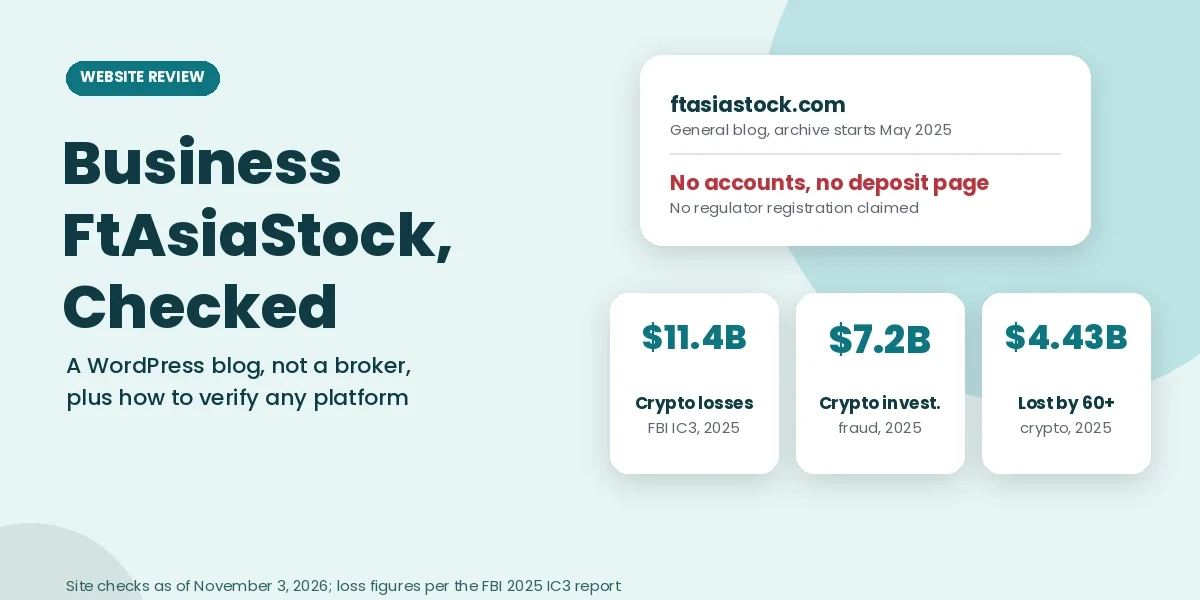
FtAsiaStock is a WordPress blog, not a broker. The site at ftasiastock.com publishes general articles and, as of November 3, 2026, shows no trading accounts, no deposit page and no claim of registration with any financial regulator.
That distinction matters because searches for “business FtAsiaStock” and “FtAsiaStock crypto” now return a mix of blog posts, exchange marketing pages and spam. This guide sorts out what the name refers to and how to check any platform before you send it money.
What business FtAsiaStock is: a general blog, not a trading platform
The homepage carries the tagline “Powering Investment Through Insight.” Its menu lists categories for crypto, finance, tech and business, alongside home improvement, law, food, auto, health and games.
The recent posts do not focus on markets. In October 2026, ftasiastock.com published pieces on accounting firm software, ignition interlock devices in Australia, used car dealers in Indiana and air quality in welding shops.
What the FtAsiaStock business section covers
The Business category reads like a small-business advice column. Recent titles cover ERP budgets for mid-size firms, email deliverability, EV charging for companies and questions to ask a real estate agent.
Some posts appear to sit in the wrong category. A June 2026 article about a lush green patch in a lawn is filed under Business. Several posts also center on Australian topics, such as Sydney courts and NDIS disability support, despite the site’s stated Asian focus.
Who runs ftasiastock.com
The About page says the site’s mission is finance, stock market and business content “particularly within the Asian region.” It names no editor, no company and no physical address.
The only contact listed is an email address on the cjadverts.com domain. The same page invites guest post submissions and says sponsored content will be labeled. The archive shows posts starting in May 2025.
None of this makes the blog harmful. It does mean ftasiastock.com is a content site, and its articles carry no more authority than any other unvetted blog. Treat any stock or crypto claim you read there as unverified until you confirm it elsewhere.
Why “FtAsiaStock crypto” became a search term
A Phemex Academy article reported that searches for “FTAsiaStock Crypto” hit “Breakout” status on Google Trends. It attributed part of the spike to dozens of low-authority review blogs publishing near-identical posts in the same week.
The same Phemex piece said the name had no transparent licensing in the US, EU, Singapore, Hong Kong or Japan. Readers should note that Phemex is itself a crypto exchange, and the article promotes Phemex’s own products as the alternative.
Spam pages around the business FtAsiaStock keyword
A search for “business ftasiastock” on November 3, 2026 returned pages hosted on Mexican municipal sites and Vietnamese and Indian college domains. Each page listed dozens of unrelated finance terms, such as currency conversions and ticker symbols, under labels like “US Equity Market Profile.”
These pages contain no real data about FtAsiaStock. Their pattern matches keyword spam placed on unrelated domains. Their presence in search results says nothing about whether any FtAsiaStock product exists.
How to verify FtAsiaStock or any broker’s registration
US regulators split oversight by product. The right database depends on what the firm says it does. The table below maps each activity to the place to check it.
| What the firm offers | Regulator | Where to check |
|---|---|---|
| Stock and bond trading through a broker | FINRA and SEC | FINRA BrokerCheck |
| Investment advice or managed accounts | SEC or state regulator | Investor.gov (IAPD records) |
| Futures, options, forex or crypto derivatives | CFTC | NFA BASIC, CFTC RED List |
| Buying and selling crypto on the spot market | FinCEN and state regulators | FinCEN MSB search, NMLS Consumer Access |
| Unregistered firms posing as registered | SEC and CFTC | SEC PAUSE list, CFTC RED List |
Step-by-step registration check
- Write down the exact legal name, website domain and any registration number the platform claims. Scam sites often copy the name of a real firm with a slight change.
- Search the firm on FINRA BrokerCheck by name or CRD number. The SEC notes that reports are free and firms are not told when you search.
- Run the same name through Investor.gov to catch investment advisers that BrokerCheck may route elsewhere.
- For crypto derivatives or forex, search NFA BASIC. The CFTC says firms that advise on or facilitate trading in virtual currency futures must register with the CFTC and NFA.
- For a plain crypto exchange, check the FinCEN MSB Registrant Search and NMLS. The CFTC notes that spot crypto sites do not register with it, though it keeps anti-fraud authority over those markets.
- Check the CFTC RED List and SEC PAUSE list. If the firm appears in no database at all, ask it why before you deposit anything.
For FtAsiaStock, the first step already answers the question. The site offers no accounts, so there is nothing to register. Any app or exchange using the FtAsiaStock name to take deposits would need to pass the checks above on its own.
Crypto fraud losses reported to the FBI
The scale of losses explains why regulators push these checks. The FBI’s Internet Crime Complaint Center received 1,008,597 complaints in 2025, with reported losses of $20.877 billion, a 26% increase from 2024.
Complaints that involved cryptocurrency reached $11.366 billion in 2025, according to the 2025 IC3 report. That figure rose 22% from the $9.3 billion recorded in 2024.
Cryptocurrency investment fraud alone accounted for $7.2 billion of the 2025 total, up from $5.8 billion in 2024. Americans aged 60 and older reported $4.43 billion in crypto-related losses, more than any other age group.
The IC3 also logged more than 10,500 complaints about recovery scams in 2025, with about $1.4 billion in losses. These schemes target people who already lost money, often posing as law firms or government staff.
Red flags regulators link to fake trading websites
In April 2019, the SEC and CFTC issued a joint investor alert on fraudulent digital asset and crypto trading websites. It told investors to check license and registration status on Investor.gov, since many frauds involve unregistered firms.
A December 2025 SEC case shows how these schemes work. The SEC charged three purported crypto platforms, Morocoin, Berge and Cirkor, along with four investment clubs, with taking $14 million from retail investors.
According to the SEC complaint, the platforms falsely claimed government licenses. No trading took place on them. The clubs recruited victims through social media and WhatsApp groups that shared supposed AI-generated stock tips.
Warning signs drawn from these SEC and CFTC actions include:
- An invitation to a group chat from someone you have never met
- A license claim you cannot find in any regulator database
- Returns that look fixed, daily or far above market rates
- Pressure to deposit more after a small early “profit”
- Withdrawal fees or taxes demanded before you can access funds
Management tips FtAsiaStock readers can apply at work
Many readers find ftasiastock.com while looking for business advice. If you manage a team or a company budget, the same verification habits apply to vendors and partners.
Verify the source before acting on business content
Check whether an article lists an author, a date and links to primary sources. Posts on ftasiastock.com show a date and a generic “admin” byline, with no named author or source links. Use such content for ideas, then confirm figures with official data before they reach a board deck or budget.
Put a registration check into treasury policy
If your company holds cash or crypto with any outside platform, write a rule that someone must run the BrokerCheck, NFA or FinCEN check first. Record the result and the date. Repeat it each year, since registrations can lapse.
Train staff on social media investment pitches
The FBI reports that crypto investment scams often start through social media, text messages or dating platforms. A short briefing on the warning signs above costs little and covers employees who manage their own savings, too.
FAQ
Is FtAsiaStock a legitimate broker?
No. FtAsiaStock is a general-interest WordPress blog. As of November 2026, ftasiastock.com offers no trading accounts and claims no broker registration, so there is no brokerage service to assess.
Is FtAsiaStock crypto safe to use?
No verified FtAsiaStock crypto exchange exists in public regulator records. Any platform using that name to take deposits should be checked on NFA BASIC, FinCEN and NMLS first. Treat it as unverified until it appears there.
Who owns ftasiastock.com?
The site does not name an owner, editor or company. Its About page lists only an email address on the cjadverts.com domain and invites guest post submissions.
How do I check if a crypto platform is registered in the US?
Search NFA BASIC for futures and derivatives firms. For spot crypto exchanges, use the FinCEN MSB Registrant Search and NMLS. Also check the CFTC RED List and SEC PAUSE list for flagged entities.
Where can I report a suspected crypto scam?
File a complaint with the FBI at ic3.gov. You can also submit a tip to the SEC or the CFTC, and to your state securities regulator if the firm solicited you directly.